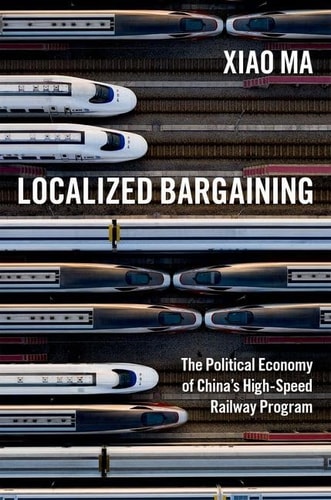
Localized Bargaining The Political Economy of China's High-Speed Railway Program
0
0
As an Amazon Associate and affiliate partner, Menrva Books earns from qualifying purchases. Learn more
Author Description
Looks at the rollout of one of the largest infrastructure programs in human history to show how local governments play a complex role. China's high-speed railway network is one of the largest infrastructure programs in human history. Despite global media coverage, we know very little about the political process that led the government to invest in the railway program and the reasons for the striking regional and temporal variation in such investments. In Localized Bargaining, Xiao Ma offers a novel theory of intergovernmental bargaining that explains the unfolding of China's unprecedented high-speed railway program. Drawing on a wealth of in-depth interviews, original data sets, and surveys with local officials, Ma details how the bottom-up bargaining efforts by territorial authorities--whom the central bureaucracies rely on to implement various infrastructure projects--shaped the allocation of investment in the railway system. Demonstrating how localities of different types invoke institutional and extra-institutional sources of bargaining power in their competition for railway stations, Ma sheds new light on how the nation's massive bureaucracy actually functions.
Menrva's Summary
THE THESIS
This book investigates the political economy behind China's massive high-speed railway program, focusing on the role of local governments. Xiao Ma's work delves into the complex intergovernmental bargaining processes that shaped the allocation of investment across China's high-speed rail network. By drawing on extensive interviews, original data, and surveys with local officials, the book reveals how territorial authorities utilized both institutional and extra-institutional power to compete for railway infrastructure. This analysis provides critical insights into the functioning of China's large bureaucracy and the dynamics of bottom-up project implementation.
THE SCOPE MAP
- Analysis of the political economy of China's high-speed railway program.
- Theory of intergovernmental bargaining to explain investment allocation.
- In-depth interviews with local officials.
- Original data sets and surveys with local authorities.
- Demonstration of how localities compete for railway stations.
- Examination of institutional and extra-institutional bargaining power.
- Insights into the functioning of China's national bureaucracy.
THE AUTHORITY PERSPECTIVE
The book offers a novel theory of intergovernmental bargaining to explain the development of China's high-speed railway program. It details how local governments, through bottom-up bargaining, influenced investment allocation and the placement of railway stations. The research is grounded in extensive interviews and original data, providing a granular view of bureaucratic function. This work is positioned to shed new light on the practical mechanisms driving large-scale infrastructure projects in China.
Page Count:
248
Publication Date:
2022-01-01
Publisher:
Oxford University Press
ISBN-10:
0197648223
ISBN-13:
9780197648223
Economics
Politics
Non-Fiction
Government
China Studies
Infrastructure
Community Tags
Similar Books