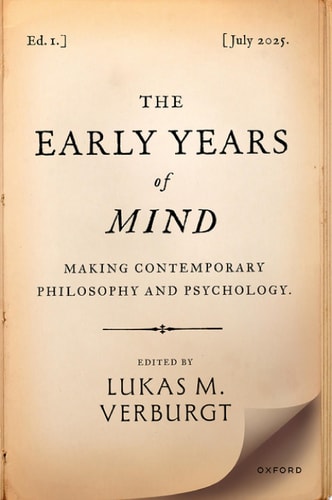
The Early Years of Mind: Making Contemporary Philosophy and Psychology
0
0
As an Amazon Associate and affiliate partner, Menrva Books earns from qualifying purchases. Learn more
Author Description
The Early Years of Mind offers a panoramic overview as well as in-depth accounts of the first decades of Mind - one of the leading philosophical journals since almost 150 years. Founded in 1876 by Alexander Bain, it soon published some of the best new work in Anglophone philosophy and psychology, containing contributions from major and once well-known but today largely forgotten authors, from Herbert Spencer to Bertrand Russell and from J.M.E. McTaggart to E.E. Constance Jones.Mind's ambition was to provide a platform for study and discussion of the scientific status of philosophy and psychology, whose intellectual and professional standing and boundaries were yet unsettled. A focus on the contents of Mind in the first forty years of its existence not only helps unearth a revealing historical picture of the major topics, themes and traditions that dominated philosophy at the turn of the nineteenth century, including evolutionary thinking and the rise of idealist and analytic philosophers. It also makes it possible to recognize their relevance to present-day endeavours. Mind's contributors addressed issues that still (or, sometimes: again) concern us today: What is the relation between philosophy and psychology? Should philosophers be knowledgeable of the latest scientific advances, and if so, how? What is the significance of philosophy for the natural and exact sciences? And what for society? Last but not least, a close look at Mind under George Croom Robertson and G.F. Stout offers a forceful reminder of the prominent role of women philosophers in Britain and America, participating in philosophical and psychological discussion despite numerous constraints.Bringing together a diverse team of eminent and emergent scholars, this pioneering volume tells the fascinating story of Mind's early years and, in so doing, sheds light on larger questions about the history of philosophy and psychology at a time of disciplinary self-experimentation.
Menrva's Summary
THE THESIS
This volume investigates how the early decades of the journal Mind shaped the professional boundaries and intellectual trajectory of philosophy and psychology at the turn of the nineteenth century. Lukas M. Verburgt, a scholar specializing in the history of philosophy and science, compiles a series of essays that examine the journal's foundational years under editors George Croom Robertson and G.F. Stout. By analyzing the contributions of figures ranging from Herbert Spencer to E.E. Constance Jones, the book argues that the journal served as a critical site for disciplinary self-experimentation and the negotiation of philosophy's relationship with the natural sciences.
THE SCOPE MAP
What You Will Find
- Historical analysis of the journal Mind from its founding in 1876 through its first forty years.
- Examination of the shifting professional boundaries between philosophy and psychology.
- Documentation of the contributions of women philosophers in Britain and America during the late nineteenth and early twentieth centuries.
- Discussion of major intellectual traditions including evolutionary theory, idealism, and the emergence of analytic philosophy.
Scope Limits
- The analysis is primarily restricted to the first four decades of the journal's publication history.
- The text focuses on the Anglophone philosophical tradition rather than a global history of the discipline.
THE AUTHORITY PERSPECTIVE
Experts identify this volume as a significant contribution to the history of academic journals and the professionalization of philosophy. Readers frequently note the academic density of the prose, which is well-suited for researchers and students of intellectual history.
Page Count:
432
Publication Date:
2025-06-06
Publisher:
Oxford University Press
ISBN-10:
0192869299
ISBN-13:
9780192869296
Philosophy
Psychology
Politics
Science History
Academic History
Intellectual History
Philosophy history
History & Schools of Thought
Community Tags
Similar Books