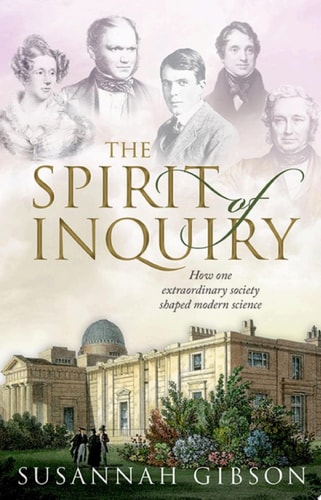
The Spirit of Inquiry: How One Extraordinary Society Shaped Modern Science
0
0
As an Amazon Associate and affiliate partner, Menrva Books earns from qualifying purchases. Learn more
Author Description
Cambridge is now world-famous as a centre of science, but it wasn't always so. Before the nineteenth century, the sciences were of little importance in the University of Cambridge. But that began to change in 1819 when two young Cambridge fellows took a geological fieldtrip to the Isle of Wight. Adam Sedgwick and John Stevens Henslow spent their days there exploring, unearthing dazzling fossils, dreaming up elaborate theories about the formation of the earth, and bemoaning the lack of serious science in their ancient university. As they threw themselves into the exciting new science of geology - conjuring millions of years of history from the evidence they found in the island's rocks - they also began to dream of a new scientific society for Cambridge. This society would bring together like-minded young men who wished to learn of the latest science from overseas, and would encourage original research in Cambridge. It would be, they wrote, a society "to keep alive the spirit of inquiry". Their vision was realised when they founded the Cambridge Philosophical Society later that same year. Its founders could not have imagined the impact the Cambridge Philosophical Society would have: it was responsible for the first publication of Charles Darwin's scientific writings, and hosted some of the most heated debates about evolutionary theory in the nineteenth century; it saw the first announcement of x-ray diffraction by a young Lawrence Bragg - a technique that would revolutionise the physical, chemical and life sciences; it published the first paper by C.T.R. Wilson on his cloud chamber - a device that opened up a previously-unimaginable world of sub-atomic particles. 200 years on from the Society's foundation, this book reflects on the achievements of Sedgwick, Henslow, their peers, and their successors. Susannah Gibson explains how Cambridge moved from what Sedgwick saw as a "death-like stagnation" (really little more than a provincial training school for Church of England clergy) to the powerhouse of scientific discovery we know today.
Menrva's Summary
THE THESIS
This book investigates how the founding of the Cambridge Philosophical Society in 1819 catalyzed the transformation of the University of Cambridge into a global hub for scientific research. Susannah Gibson, a historian of science, utilizes archival records and the personal correspondence of founders Adam Sedgwick and John Stevens Henslow to document this institutional shift. She argues that the society provided the necessary infrastructure and intellectual community to move the university away from traditional, stagnant curricula toward the rigorous pursuit of modern scientific inquiry.
THE SCOPE MAP
What You Will Find
- The historical development of the Cambridge Philosophical Society from 1819 to the present.
- Biographical accounts of key figures including Sedgwick, Henslow, Charles Darwin, and Lawrence Bragg.
- Analysis of the societal impact on major scientific breakthroughs, such as evolutionary theory and x-ray diffraction.
Scope Limits
- The book does not provide a comprehensive history of the entire University of Cambridge, focusing primarily on the influence of the Philosophical Society.
- It does not offer a technical manual for the scientific instruments mentioned, such as the cloud chamber.
THE AUTHORITY PERSPECTIVE
Experts and historians of science frequently commend this work for its accessible narrative style and its ability to contextualize institutional change within the broader history of ideas. Readers often note that the text successfully balances detailed biographical anecdotes with a clear analysis of the structural evolution of scientific research in the nineteenth century.
Page Count:
399
Publication Date:
2019-01-01
Publisher:
OUP Oxford
ISBN-10:
0192569880
ISBN-13:
9780192569882
History
Biography
Science History
Intellectual History
Science
British History
Academic History
Earth Sciences
Community Tags
Similar Books
Reader Comments
Share Your Thoughts
No comments yet. Be the first to share your thoughts!