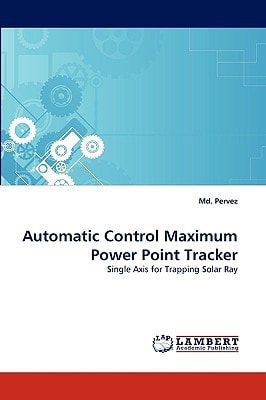
Automatic Control Maximum Power Point Tracker
0
0
As an Amazon Associate and affiliate partner, Menrva Books earns from qualifying purchases. Learn more
Author Description
A single-axis Sun tracker to follow the position of the sun was designed and constructed and an experimental investigation was carried out on photovoltaic power output through the single axis automatic controlled solar tracker. This paper presents the design of an Automatic Solar tracking system to track Solar PV Panel according to the direction of beam propagation of Sun s radiation. The entire tracking system consists of sensor with ADC, control circuits to motor drive with control software, and bearing with supports and mountings. The controlling motion for PV panel has been provided by discrete motion of the motor. Microcontrollers with ADC and line driver are used in the control circuits, which generate pulses according to software feedback for rotation of the motor drive. The amount of receivable solar insulation through tracking is considered as 100% at all latitude and energy surplus becomes about 57% without atmospheric influences. In case of seasonal changes of the Sun s position, it needs not to change hardware & software. Considering all above aspects of this tracking system it can be concluded that, it is a flexible tracking system with least cost & high efficiency.
Menrva's Summary
THE THESIS
This paper details the design and experimental validation of an automatic single-axis solar tracker aimed at maximizing photovoltaic power output. The system integrates sensors, microcontrollers with ADC, and motor drives to precisely follow the sun's position, thereby increasing solar energy capture. The design emphasizes flexibility, low cost, and high efficiency, with a claimed energy surplus of approximately 57% without atmospheric influences, and requires no hardware or software adjustments for seasonal changes.
THE SCOPE MAP
- Design and construction of a single-axis solar tracker.
- Experimental investigation of photovoltaic power output.
- Integration of sensors with ADC for sun position detection.
- Control circuits utilizing microcontrollers and line drivers.
- Motor drive system for discrete motion of the PV panel.
- Software feedback for motor rotation control.
- Analysis of solar insulation capture and energy surplus.
- Evaluation of system flexibility, cost, and efficiency.
THE AUTHORITY PERSPECTIVE
The presented work focuses on the practical implementation and performance analysis of an automatic solar tracking system. The design emphasizes a balance between cost-effectiveness and efficiency, suggesting a practical solution for enhancing solar energy harvesting. The experimental investigation aims to quantify the gains achievable through precise tracking, considering factors like solar insulation and seasonal variations. The conclusion highlights the system's flexibility and efficiency as key advantages.
Page Count:
100
Publication Date:
2010-05-10
Publisher:
Lap Lambert Academic Publishing GmbH KG
ISBN-10:
3838364880
ISBN-13:
9783838364889
Non-Fiction
Science
Solar power
Automation
Electronics
Engineering
Community Tags
Similar Books