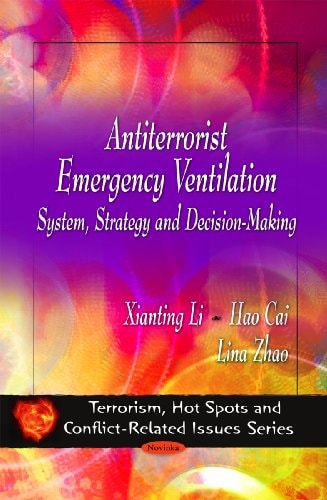
Antiterrorist Emergency Ventilation System, Strategy and Decision-making
0
0
As an Amazon Associate and affiliate partner, Menrva Books earns from qualifying purchases. Learn more
Author Description
There are two kinds of antiterrorist emergency ventilation system. One is to defend indoor environment against chemical and biological agent (CBA) attacks. The other is to supply calmative gas to incapacitate terrorists when they hold hostages in public buildings. What kind of system and ventilation strategy can be used for antiterrorism, and how to make decision are introduced in the book. There are six sections in the book. How the emergency ventilation systems work is introduced in the first section. The second section is on the theory of contaminant dispersion and identification of contaminant source. For the theory of contaminant dispersion, both computational fluid dynamics (CFD) method and analytical formula of contaminant distribution are introduced. For the theory of contaminant source identification, an algorithm to identify the position and intensity of contaminant source with limited number of sensors is proposed and demonstrated for its effectiveness. The third section is on the evacuation model and evaluation of exposure risk. Both cellular automata (CA) model and spatial-grid evacuation model (SGEM) are introduced for modelling evacuation process. The relative exposure risk index, EFCS, and absolute exposure risk index, PIR, are introduced to evaluate the exposure risk of contaminant. Both the second section and third section are the fundamental of emergency ventilation. Based on section 2 and 3, the ventilation strategy and decision-making are introduced for emergency ventilation against contaminant suddenly released in public building in section 4 and for emergency ventilation to rescue hostages held by terrorists in section 5, respectively. Section 6 is the summary of the whole book.
Menrva's Summary
THE THESIS
This book investigates the design, strategy, and decision-making processes for antiterrorist emergency ventilation systems, addressing both environmental defense against chemical/biological attacks and tactical incapacitation of terrorists. The authors, Hao Cai, Lina Zhao, and Xianting Li, present a comprehensive analysis drawing on computational fluid dynamics, analytical formulas for contaminant dispersion, and algorithms for source identification. The work is structured into six sections, beginning with the fundamental principles of emergency ventilation systems and contaminant behavior, progressing to evacuation modeling and risk assessment, and culminating in specific strategies for antiterrorist applications.
THE SCOPE MAP
- Principles and operation of antiterrorist emergency ventilation systems.
- Theories of contaminant dispersion, including CFD and analytical formulas.
- Algorithms for identifying contaminant source position and intensity using limited sensors.
- Evacuation modeling using cellular automata (CA) and spatial-grid evacuation models (SGEM).
- Evaluation of exposure risk using indices like EFCS and PIR.
- Ventilation strategies for responding to sudden contaminant releases in public buildings.
- Ventilation strategies for incapacitating terrorists holding hostages.
THE AUTHORITY PERSPECTIVE
This technical work appears to be a specialized academic or professional text, likely intended for engineers, security professionals, and researchers in the fields of ventilation, disaster management, and counter-terrorism. Its detailed approach to contaminant dispersion, source identification, and evacuation modeling suggests a rigorous, data-driven analysis. The book's structure, moving from fundamental theories to applied strategies, indicates a comprehensive treatment of its subject matter, aiming to provide actionable insights for designing and implementing effective antiterrorist emergency ventilation systems.
Page Count:
95
Publication Date:
2009-01-01
Publisher:
Nova Science Publishers
ISBN-10:
1607410419
ISBN-13:
9781607410416
Non-Fiction
Science & Technology
Science
Public Safety
Security
Engineering
Community Tags
Similar Books