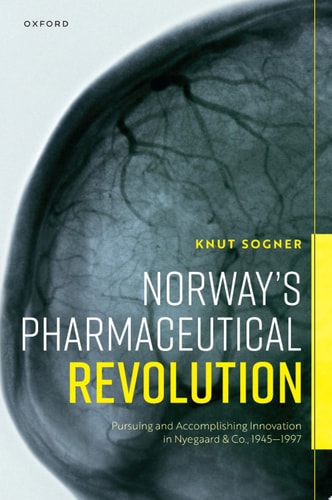
Norway's Pharmaceutical Revolution: Pursuing and Accomplishing Innovation in Nyegaard & Co., 1945-1997
0
0
As an Amazon Associate and affiliate partner, Menrva Books earns from qualifying purchases. Learn more
Author Description
The pharmaceutical revolution that gathered pace in the 1930s delivered a plethora of almost magical new drugs such as penicillin, streptomycin, cortisone, and the birth control pill. This revolution grew from academic-business relationships in five countries: USA, Germany, Great Britain, Switzerland, and France. Many other countries tried and failed to replicate this success, yet a handful of Scandinavia companies made important breakthroughs in a narrow band of specialities. This is the story of how one Norwegian company-- Nyegaard & Co. --achieved international success from the 1970s onwards with a breakthrough product facilitating X-ray pictures of the soft tissues of the body. The company succeeded by harnessing research skills and creating scientific and business alliances abroad, building its own momentum step by step: the corporation as entrepreneur. It thereby broke with the conventional way a national medical ecosystem facilitated the crucial scientific progress. This is a story both of personal initiatives and great organizational transformations in several stages. In the 1950s, Nyegaard & Co. was a small hierarchical home market-oriented generics company. By the end of the 1990s, it had developed into a fairly large and multinational hierarchical company, preoccupied as much with shareholder value as scientific progress. It has also become a company that no longer had the same ability to innovate as before and therefore became merged into another one.
Menrva's Summary
THE THESIS
How did a small Norwegian pharmaceutical firm, Nyegaard & Co., manage to achieve international success and innovation in a field dominated by larger global powers? Knut Sogner, a historian specializing in business and industrial development, examines the evolution of Nyegaard & Co. from a local generics manufacturer into a multinational entity. By analyzing the company's strategic alliances, research initiatives, and organizational shifts between 1945 and 1997, the author argues that the firm's success stemmed from a unique ability to bridge academic research with commercial application, ultimately highlighting the lifecycle of corporate innovation.
THE SCOPE MAP
What You Will Find
- Detailed analysis of the pharmaceutical industry landscape in post-war Europe.
- Examination of the development of contrast media for X-ray imaging.
- Case study of the transition from a family-oriented firm to a shareholder-focused multinational corporation.
- Exploration of the role of international scientific and business alliances.
Scope Limits
- The study does not provide a comprehensive history of the entire Norwegian pharmaceutical sector.
- It does not cover the post-merger operations of the company beyond the late 1990s.
THE AUTHORITY PERSPECTIVE
Experts recognize this work as a significant contribution to the history of corporate innovation and the specific development of the Scandinavian medical industry. Readers frequently note the academic rigor and the detailed archival research that supports the author's conclusions regarding organizational transformation.
Page Count:
272
Publication Date:
2022-12-15
Publisher:
Oxford University Press
ISBN-10:
0192869000
ISBN-13:
9780192869005
Economic History
Corporate Strategy
Pharmaceutical Industry
Business History
Norway
Community Tags
Similar Books