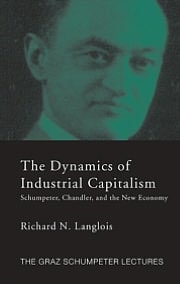
Dynamics of Industrial Capitalism: Schumpeter, Chandler, and the New Economy
0
0
As an Amazon Associate and affiliate partner, Menrva Books earns from qualifying purchases. Learn more
Author Description
Weaving Together Business History, Economic Theory And The History Of Ideas, Langlois Sorts Through The Competing Understanding Of The Rise And (relative) Eclipse Of The Multi-unit Enterprise. Rather Than Rejecting The Accounts Of Schumpeter And Chandler, Langlois Instead Offers His Own Nuanced And Historically Grounded Account Of The Rise And Success Of The Corporation And Its Subsequent Unbundling.--jacket. Progressive Rationalization -- The Obsolescence Of The Entrepreneur -- Personal Capitalism -- The Rise Of The Corporation -- The Return Of The Entrepreneur. Richard N. Langlois. Includes Bibliographical References (p. [104]-116) And Index.
Menrva's Summary
THE THESIS
This work investigates the evolution of the multi-unit enterprise by reconciling the theoretical frameworks of Joseph Schumpeter and Alfred Chandler with the realities of the modern economy. Richard N. Langlois, a professor of economics, synthesizes business history and the history of ideas to explain why large corporations rose to dominance and why they have recently undergone a process of unbundling. By examining the interplay between technological change and organizational structure, the author provides a nuanced account of how the role of the entrepreneur has shifted over the last century.
THE SCOPE MAP
What You Will Find
- An analysis of the rise and subsequent decline of the vertically integrated multi-unit corporation.
- A comparative evaluation of Schumpeterian innovation theory and Chandlerian organizational history.
- Historical case studies tracing the transition from personal capitalism to corporate management.
- A theoretical framework explaining the return of the entrepreneur in the modern, unbundled economy.
THE AUTHORITY PERSPECTIVE
Experts recognize this text as a sophisticated bridge between historical business analysis and contemporary economic theory. Readers frequently note the academic density of the prose, which is intended for students and scholars of institutional economics and industrial organization.
Page Count:
122
Publication Date:
2007-01-01
Publisher:
Taylor & Francis Group
ISBN-10:
0203963636
ISBN-13:
9780203963630
Economics
Big Business
Economic Theory
Business History
Capitalism
Corporate Strategy
Community Tags
Similar Books