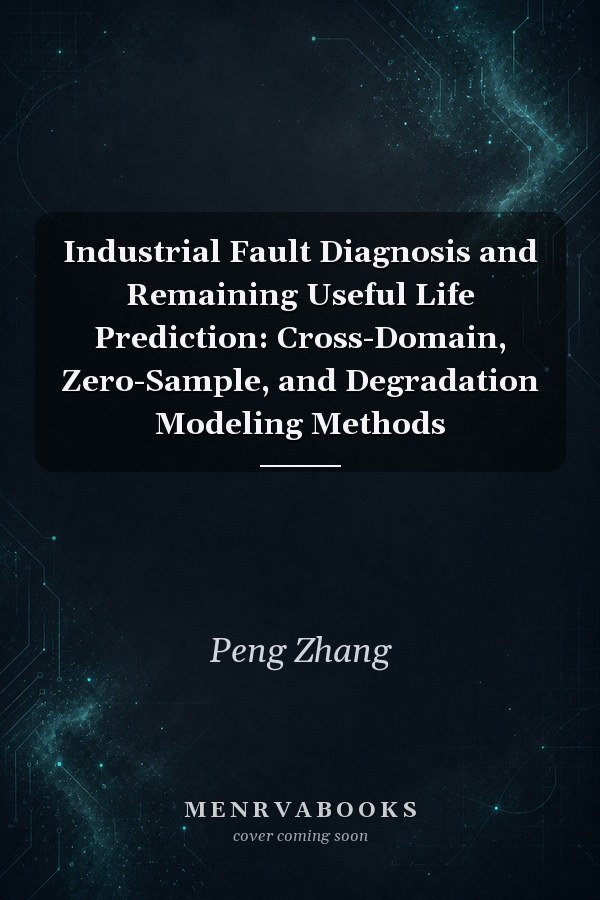
Industrial Fault Diagnosis and Remaining Useful Life Prediction: Cross-Domain, Zero-Sample, and Degradation Modeling Methods
0
0
As an Amazon Associate and affiliate partner, Menrva Books earns from qualifying purchases. Learn more
Author Description
Industrial Fault Diagnosis and Remaining Useful Life Prediction: Cross-Domain, Zero-Sample, and Degradation Modeling Methods introduces zero-sample learning methods that enable fault diagnosis and Predict Remaining Useful Life (RUL) without the need for labelled fault data. This is particularly valuable in industrial settings where labelled data is scarce or unavailable. Offers step-by-step guidance on implementing zero-shot learning models using real industrial data, reducing the learning curve for practitioners; includes real-world industrial case studies to demonstrate the application of zero-sample learning techniques in various industries, such as manufacturing, energy, and transportation. Such case studies provide readers with actionable insights and practical solutions. The book covers advanced methodologies for predicting the remaining useful life of industrial equipment, supporting readers in optimizing maintenance schedules, reducing downtime and extending the lifespan of critical assets. Covers state-of-the-art algorithms, including deep learning, transfer learning and domain adaptation, tailored for zero-sample scenarios. These tools empower readers to develop robust fault diagnosis and RUL prediction systems, enhancing predictive maintenance capabilities and ensuring the reliability of industrial systems.
Menrva's Summary
THE THESIS
This book addresses the critical challenge of industrial fault diagnosis and Remaining Useful Life (RUL) prediction in scenarios where labeled fault data is scarce or nonexistent. It introduces zero-sample learning methods, enabling accurate predictions without prior fault examples. The authors provide practical guidance for implementing these advanced models using real industrial data, supported by case studies across manufacturing, energy, and transportation sectors, offering actionable insights for optimizing maintenance and extending asset lifespan.
THE SCOPE MAP
- Zero-sample learning methods for fault diagnosis and RUL prediction without labeled data.
- Step-by-step implementation guidance for zero-shot learning models using real industrial data.
- Real-world industrial case studies from manufacturing, energy, and transportation sectors.
- Advanced methodologies for predicting the remaining useful life of industrial equipment.
- Optimization of maintenance schedules, reduction of downtime, and extension of asset lifespan.
- Coverage of state-of-the-art algorithms including deep learning, transfer learning, and domain adaptation for zero-sample scenarios.
- Development of robust fault diagnosis and RUL prediction systems to enhance predictive maintenance capabilities.
THE AUTHORITY PERSPECTIVE
The book is positioned as a practical guide for engineers and researchers dealing with data scarcity in industrial fault diagnosis and RUL prediction. Its focus on zero-sample learning and real-world case studies suggests it aims to bridge the gap between theoretical advancements and practical industrial application. The inclusion of advanced algorithms like deep learning and transfer learning indicates a comprehensive approach to modern predictive maintenance challenges. The emphasis on actionable insights and optimized maintenance schedules points to a readership seeking to improve the reliability and efficiency of industrial systems.
Page Count:
200
Publication Date:
2026-02-01
Publisher:
Elsevier Science
ISBN-10:
0443442916
ISBN-13:
9780443442919
Non-Fiction
Science & Technology
Engineering
Machine Learning
Community Tags
Similar Books