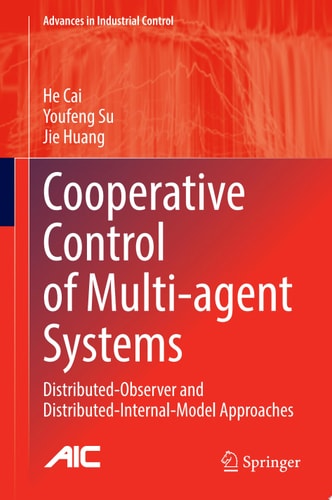
Cooperative Control of Multi-agent Systems
0
0
As an Amazon Associate and affiliate partner, Menrva Books earns from qualifying purchases. Learn more
Author Description
The main focus of this book is a pair of cooperative control problems: consensus and cooperative output regulation. Its emphasis is on complex multi-agent systems characterized by strong nonlinearity, large uncertainty, heterogeneity, external disturbances and jointly connected switching communication topologies. The cooperative output regulation problem is a generalization of the classical output regulation problem to multi-agent systems and it offers a general framework for handling a variety of cooperative control problems such as consensus, formation, tracking and disturbance rejection. The book strikes a balance between rigorous mathematical proof and engineering practicality. Every design method is systematically presented together with illustrative examples and all the designs are validated by computer simulation. The methods presented are applied to several practical problems, among them the leader-following consensus problem of multiple Euler–Lagrangesystems, attitude synchronization of multiple rigid-body systems, and power regulation of microgrids. The book gives a detailed exposition of two approaches to the design of distributed control laws for complex multi-agent systems—the distributed-observer and distributed-internal-model approaches. Mastering both will enhance a reader’s ability to deal with a variety of complex real-world problems. Cooperative Control of Multi-agent Systems can be used as a textbook for graduate students in engineering, sciences, and mathematics, and can also serve as a reference book for practitioners and theorists in both industry and academia. Some knowledge of the fundamentals of linear algebra, calculus, and linear systems are needed to gain maximum benefit from this book. Advances in Industrial Control reports and encourages the transfer of technology in control engineering. The rapid development of control technology has an impact on all areas of the control discipline. The series offers an opportunity for researche
Menrva's Summary
THE THESIS
This book investigates the challenges of coordinating multiple autonomous agents to achieve a common goal, focusing on consensus and cooperative output regulation. It addresses complex multi-agent systems that exhibit strong nonlinearity, significant uncertainty, heterogeneity, external disturbances, and dynamically changing communication networks. The cooperative output regulation problem is presented as a generalized framework for various cooperative control tasks, including consensus, formation, tracking, and disturbance rejection, offering a bridge between theoretical concepts and practical engineering applications. The narrative framework is analytical and problem-solution oriented, supported by rigorous mathematical proofs and validated through illustrative examples and computer simulations.
THE SCOPE MAP
- Detailed exposition of distributed-observer and distributed-internal-model approaches for designing control laws.
- Coverage of complex multi-agent systems with nonlinearity, uncertainty, heterogeneity, and switching communication topologies.
- Application of methods to practical problems such as leader-following consensus in Euler-Lagrange systems, attitude synchronization of rigid bodies, and power regulation in microgrids.
- Rigorous mathematical proofs balanced with engineering practicality.
- Illustrative examples and computer simulations for validation of design methods.
- Discussion of consensus and cooperative output regulation as core problems.
THE AUTHORITY PERSPECTIVE
The book is designed as a textbook for graduate students in engineering, sciences, and mathematics, and as a reference for industry and academic practitioners. Its content requires foundational knowledge in linear algebra, calculus, and linear systems. The methods presented are applied to real-world problems, suggesting a focus on practical applicability alongside theoretical rigor. The series 'Advances in Industrial Control' aims to facilitate technology transfer in control engineering.
Page Count:
383
Publication Date:
2022-05-31
Publisher:
Springer Nature
ISBN-10:
3030983773
ISBN-13:
9783030983772
Non-Fiction
Science
Control systems
Mathematics
Engineering
Robotics
Community Tags
Similar Books






Reader Comments
Share Your Thoughts
No comments yet. Be the first to share your thoughts!