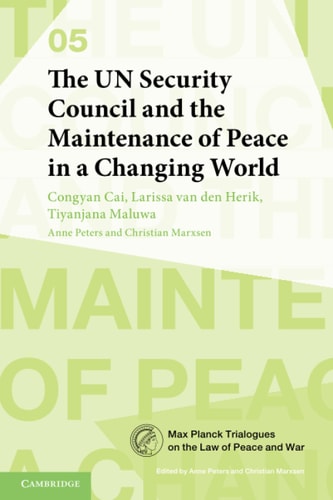
The UN Security Council and the Maintenance of Peace in a Changing World
0
0
As an Amazon Associate and affiliate partner, Menrva Books earns from qualifying purchases. Learn more
Author Description
How can the UN Security Council contribute to the maintenance of international peace and security in times of heightened tensions, global polarisation, and contestation about the principles underlying the international legal and political order? In this Trialogue, experts with diverse geographic, socio-legal, and ideational backgrounds present their perspectives on the Security Council's historic development, its present functions and deficits, and its defining tensions and future trajectories. Three approaches engage with each other: a power-focused approach emphasising the role of China as an emerging actor; an institutionalist perspective exploring how less powerful states, particularly the elected members of the Security Council, exert influence and may strengthen rule-of-law standards; a regionalist perspective investigating how the Security Council as the central actor can cooperate with regional organisations towards maintaining international peace and security. This title is also available as Open Access on Cambridge Core.
Menrva's Summary
THE THESIS
How can the UN Security Council effectively maintain international peace and security amidst escalating global tensions and ideological divides? This book explores the UN Security Council's evolving role by presenting diverse expert perspectives on its historical development, current challenges, and future direction. It examines the influence of emerging powers like China, the strategies employed by less powerful states to exert influence and uphold rule-of-law standards, and the potential for cooperation between the Security Council and regional organizations to ensure global stability.
THE SCOPE MAP
- Analysis of the UN Security Council's historical development and its present functions and deficits.
- Exploration of the role of China as an emerging actor in international security.
- An institutionalist perspective on how less powerful states influence the Security Council and strengthen rule-of-law standards.
- A regionalist perspective on cooperation between the Security Council and regional organizations for peace maintenance.
- Discussion of defining tensions and future trajectories for the Security Council in a changing world.
THE AUTHORITY PERSPECTIVE
This title presents a multi-faceted analysis of the UN Security Council's role in contemporary global politics, drawing on diverse expert viewpoints. The approach emphasizes a 'Trialogue' format, suggesting an engagement between distinct theoretical frameworks: power-focused, institutionalist, and regionalist. The book aims to provide a comprehensive overview of the Council's challenges and potential future paths, particularly in an era of increased polarization and contestation over international norms. Its publication as Open Access on Cambridge Core indicates a commitment to broad accessibility for scholars and policymakers.
Page Count:
322
Publication Date:
2024-02-22
Publisher:
Cambridge University Press
ISBN-10:
1009423444
ISBN-13:
9781009423441
Non-Fiction
History
Politics
International relations
Law
Community Tags
Similar Books