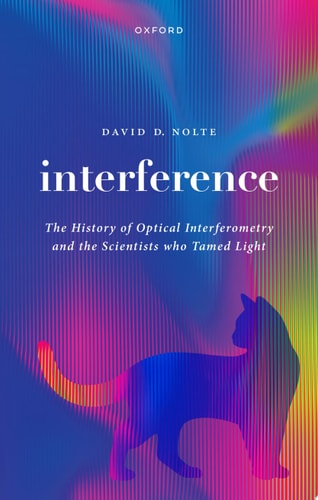
Interference: The History of Optical Interferometry and the Scientists Who Tamed Light
0
0
As an Amazon Associate and affiliate partner, Menrva Books earns from qualifying purchases. Learn more
Author Description
Ever wonder why soap bubbles become invisible right before they pop? Or why lenses are so blue they look purple? How is it possible to image black holes at the heart of distant galaxies? The answer to all these questions is Interference. This book tells the story of the science of optical interferometry - mankind's most sensitive form of measurement - and of the scientists who tamed light to make outstanding discoveries, from lasers and holograms to astronomy and quantum physics.In the past several years, interferometry has been used to discover exoplanets orbiting distant stars, to take the first image of a black hole, to detect the first gravitational waves and to create the first programmable quantum computer. This list of achievements points to the fertile and active field of interferometry for which this book provides a convenient and up - to - date guide for a wide audience interested in the science of light.
Menrva's Summary
THE THESIS
This book investigates the historical development and scientific utility of optical interferometry as the primary mechanism for high-precision measurement in modern physics. David D. Nolte, a professor of physics, synthesizes the evolution of light-based measurement techniques from early observations of thin-film interference to contemporary applications in astrophysics and quantum computing. The text argues that the ability to manipulate light waves has provided the foundational tools necessary for the most significant observational breakthroughs of the last century.
THE SCOPE MAP
What You Will Find
- Historical progression of optical interferometry from the 19th century to the present.
- Explanations of physical phenomena including thin-film interference, holography, and laser technology.
- Case studies on the detection of gravitational waves and the imaging of black holes.
Scope Limits
- The text does not provide a rigorous mathematical derivation of wave mechanics for advanced graduate-level study.
- It does not cover the entirety of general relativity, focusing only on the specific role of interferometry in its verification.
THE AUTHORITY PERSPECTIVE
Experts and readers note that the book serves as an accessible bridge between popular science and technical history. The prose is considered well-suited for students and science enthusiasts who require a clear overview of how light measurement has shaped modern experimental physics.
Page Count:
448
Publication Date:
2023-01-01
Publisher:
Oxford University Press
ISBN-10:
0192869760
ISBN-13:
9780192869760
Science
Physics
Technology
Optics
Science History
Community Tags
Similar Books