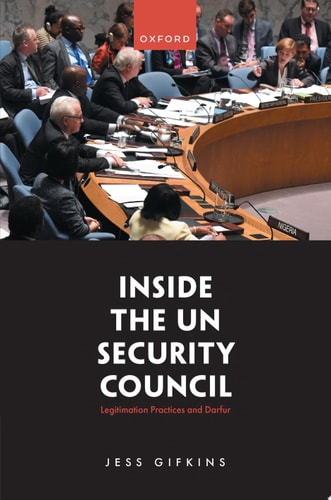
Inside the UN Security Council: Legitimation Practices and Darfur
0
0
As an Amazon Associate and affiliate partner, Menrva Books earns from qualifying purchases. Learn more
Author Description
UN Security Council decisions impact billions of people and yet its formal rules are minimal and tell us little about how decisions are made. Instead, informal, and often unwritten practices, form the basis of negotiations. Inside the UN Security Council analyses informal practices within Security Council decision-making, both in general and focused on the case of Darfur in the west of Sudan, to pull back the curtain on decision-making. Security Council negotiations on Darfur are analyzed in depth across issue areas of agenda-setting, sanctions, referral to the International Criminal Court, and peacekeeping. One way of understanding these informal practices is via the lens of legitimation. This is a useful approach because it brings to the fore the ways in which states seek legitimacy for themselves, and for Security Council decisions, as part of the negotiation process. Inside the UN Security Council introduces and develops the concept of legitimation practices to analyse the UN Security Council's decision-making. Legitimation practices shape the process and outcome of negotiations in two different ways. Internal legitimation practices, which relate to the legitimation of Security Council decisions, such as prioritizing unanimity, constrain and enable the text of resolutions. External legitimation practices such as 'doing something', even when it is known that it cannot be implemented, relate to the legitimation of actors in the negotiations and shape whether decisions can be reached at all. Foregrounding legitimation practices sheds light on seemingly contradictory moments within Security Council decision-making, such as the United States enabling the referral of the situation in Darfur to the International Criminal Court, despite its longstanding objections to the court and the capacity to veto the decision. The book draws on a wide range of primary and secondary sources, including original interviews with key decision-makers, to show that legitimation practices
Menrva's Summary
THE THESIS
How do informal, unwritten practices within the UN Security Council shape international decision-making and the legitimation of global policy? Jess Gifkins, an expert in international relations, investigates the gap between the formal rules of the UN Security Council and the actual negotiation processes. By applying the framework of legitimation practices, the author argues that states navigate internal and external pressures to justify their actions and maintain the Council's perceived authority, even when faced with complex geopolitical conflicts.
THE SCOPE MAP
What You Will Find
- Analysis of internal legitimation practices like the prioritization of unanimity.
- Examination of external legitimation practices such as performative policy-making.
- Case study of the Darfur crisis covering agenda-setting, sanctions, and ICC referrals.
- Qualitative data derived from original interviews with key diplomatic decision-makers.
Scope Limits
- The text does not provide a comprehensive history of the UN Security Council beyond the context of the Darfur negotiations.
- It does not offer a prescriptive guide for reforming UN voting procedures.
THE AUTHORITY PERSPECTIVE
Scholars and practitioners in the field of international relations recognize this work as a significant contribution to understanding the informal mechanics of global governance. Readers frequently note the academic density of the prose, which provides a rigorous look at how diplomatic actors balance national interests with international legitimacy.
Page Count:
240
Publication Date:
2024-01-01
Publisher:
Oxford University Press
ISBN-10:
0192869027
ISBN-13:
9780192869029
Politics
Conflict Resolution
World politics
Diplomacy
Darfur
Engineering
International relations
United Nations
Community Tags
Similar Books