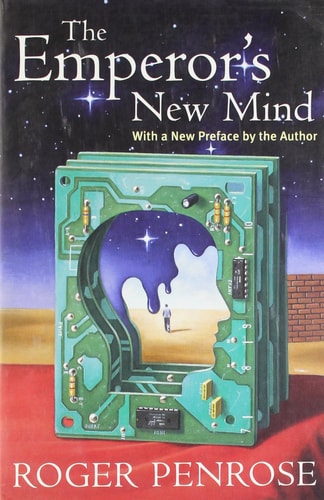
The Emperor's New Mind: Concerning Computers, Minds, and the Laws of Physics
0
0
As an Amazon Associate and affiliate partner, Menrva Books earns from qualifying purchases. Learn more
Author Description
For decades, proponents of artificial intelligence have argued that computers will soon be doing everything that a human mind can do. Admittedly, computers now play chess at the grandmaster level, but do they understand the game as we do? Can a computer eventually do everything a human mind can do?In this absorbing and frequently contentious book, Roger Penrose--eminent physicist and winner, with Stephen Hawking, of the prestigious Wolf prize--puts forward his view that there are some facets of human thinking that can never be emulated by a machine. Penrose examines what physics and mathematics can tell us about how the mind works, what they can't, and what we need to know to understand the physical processes of consciousness.He is among a growing number of physicists who think Einstein wasn't being stubborn when he said his "little finger" told him that quantum mechanics is incomplete, and he concludes that laws even deeper than quantum mechanics are essential for the operation of a mind. To support this contention, Penrose takes the reader on a dazzling tour that covers such topics as complex numbers, Turing machines, complexity theory, quantum mechanics, formal systems, Godel undecidability, phase spaces, Hilbert spaces, black holes, white holes, Hawking radiation, entropy, quasicrystals, the structure of the brain, and scores of other subjects.The Emperor's New Mind will appeal to anyone with a serious interest in modern physics and its relation to philosophical issues, as well as to physicists, mathematicians, philosophers and those on either side of the AI debate.
Menrva's Summary
THE THESIS
Can a computer eventually replicate the full spectrum of human consciousness, or are there fundamental physical limits to artificial intelligence? Roger Penrose, a renowned mathematical physicist, argues that human consciousness is non-computable and cannot be simulated by current algorithmic models. By integrating principles from quantum mechanics, general relativity, and Gödelian incompleteness, Penrose posits that the physical processes underlying the mind require a new, as-yet-undiscovered theory of physics that transcends standard quantum mechanics.
THE SCOPE MAP
What You Will Find
- Analysis of Turing machines and the limits of formal systems
- Exploration of quantum mechanics, entropy, and black hole physics
- Discussion on the biological structure of the brain and neural processes
- Examination of Gödel's incompleteness theorems in relation to human cognition
Scope Limits
- The text does not provide a complete, unified theory of consciousness
- It does not offer a practical engineering guide for building artificial intelligence
THE AUTHORITY PERSPECTIVE
Experts and readers frequently note the high academic density and technical rigor of the prose, which demands a strong background in mathematics and physics. While the work is recognized as a significant contribution to the philosophy of mind, it remains a subject of intense debate among computer scientists and neurobiologists regarding the validity of its core claims.
Page Count:
640
Publication Date:
2002-12-12
Publisher:
Oxford University Press
ISBN-10:
0192861980
ISBN-13:
9780192861986
Science
Intellect
Philosophy of
Consciousness
Mathematics
Physics
Community Tags
Similar Books