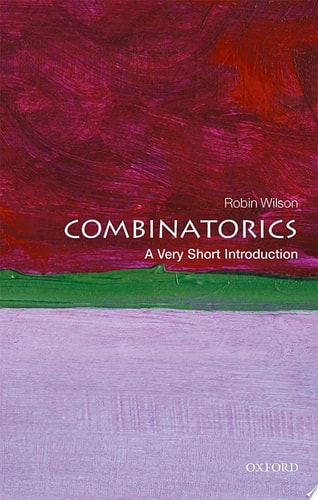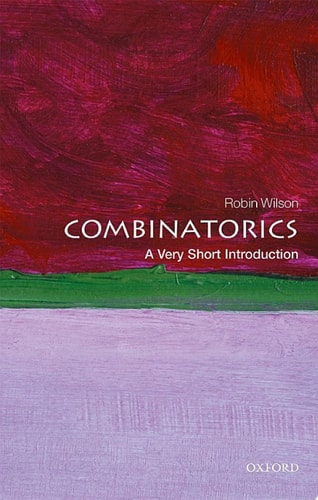
Combinatorics: A Very Short Introduction
0
0
As an Amazon Associate and affiliate partner, Menrva Books earns from qualifying purchases. Learn more
Author Description
How many possible sudoku puzzles are there? In the lottery, what is the chance that two winning balls have consecutive numbers? Who invented Pascal's triangle? (it was not Pascal) Combinatorics, the branch of mathematics concerned with selecting, arranging, and listing or counting collections of objects, works to answer all these questions. Dating back some 3000 years, and initially consisting mainly of the study of permutations and combinations, its scope has broadened to include topics such as graph theory, partitions of numbers, block designs, design of codes, and latin squares. In this Very Short Introduction Robin Wilson gives an overview of the field and its applications in mathematics and computer theory, considering problems from the shortest routes covering certain stops to the minimum number of colours needed to colour a map with different colours for neighbouring countries. ABOUT THE SERIES: The Very Short Introductions series from Oxford University Press contains hundreds of titles in almost every subject area. These pocket-sized books are the perfect way to get ahead in a new subject quickly. Our expert authors combine facts, analysis, perspective, new ideas, and enthusiasm to make interesting and challenging topics highly readable.
Menrva's Summary
THE THESIS
This book investigates the fundamental principles of combinatorics, the mathematical study of counting, arranging, and selecting objects. Robin James Wilson, a distinguished mathematician and emeritus professor, utilizes historical context and practical examples to explain how this field addresses complex problems in mathematics and computer theory. The text provides a structured framework for understanding how combinatorial methods apply to real-world scenarios ranging from map coloring to network optimization.
THE SCOPE MAP
What You Will Find
- Historical development of combinatorial mathematics over the last 3000 years
- Core concepts including permutations, combinations, and graph theory
- Applications in computer science, coding theory, and design
- Analysis of classic problems like Pascal's triangle and map coloring
Scope Limits
- Does not provide exhaustive proofs for advanced theorems
- Excludes highly specialized or niche research areas within modern combinatorics
THE AUTHORITY PERSPECTIVE
Experts and educators frequently cite this work as an accessible entry point for students and laypeople interested in discrete mathematics. Readers often note the clarity of the prose, which manages to distill complex mathematical concepts into a concise and readable format.
Page Count:
176
Publication Date:
2016-01-01
Publisher:
OUP Oxford
ISBN-10:
0191035254
ISBN-13:
9780191035258
Science
Combinatorics
Academic
Post-Calculus
Reference
Mathematics
Mathematics Statistics