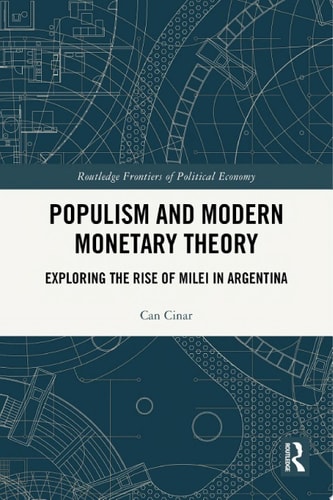
Populism and Modern Monetary Theory
0
0
As an Amazon Associate and affiliate partner, Menrva Books earns from qualifying purchases. Learn more
Author Description
Centred on Javier Milei’s recent ascent, this book explores the cyclical nature of Argentina's economic crises and the corresponding rise of populist leaders. It argues that populism represents a revolutionary stance that should be reclaimed by progressive movements, examining the relationship between financial turbulence and populist allure through the lens of heterodox economics, particularly Modern Monetary Theory. It also provides a fresh re-reading of Argentine history leading up to Milei’s presidency, using post-Keynesian framework to analyse the complex interplay between fiscal policies and political ideologies. The book demonstrates how Modern Monetary Theory can theoretically justify expansive fiscal policies central to populist platforms, enriching debates about the economic viability of populist governance. Milei's unique blend of heterodox economic policies and populist rhetoric, characterised by deregulation, privatization, and radical reductions in government spending, presents a crucial juncture for examining intersections between economic principles and populist mechanics. Integrating economic theory, historical context, and political analysis, this work contributes to political economy, heterodox economics, and Latin American studies.
Menrva's Summary
THE THESIS
This book investigates the cyclical nature of Argentina's economic crises and the rise of populist leaders, using Javier Milei's presidency as a central case study. It argues that populism, often viewed negatively, should be embraced by progressive movements, exploring the connection between financial instability and populist appeal through the lens of heterodox economics, particularly Modern Monetary Theory (MMT). The work offers a new interpretation of Argentine history leading up to Milei's election, employing a post-Keynesian framework to analyze the intricate relationship between fiscal policies and political ideologies. It demonstrates how MMT can provide a theoretical basis for the expansive fiscal policies characteristic of populist platforms, thereby contributing to discussions on the economic feasibility of populist governance.
THE SCOPE MAP
- Analysis of Javier Milei's ascent and its connection to Argentina's economic crises.
- Exploration of populism as a potentially progressive political stance.
- Examination of the relationship between financial turbulence and populist allure.
- Application of Modern Monetary Theory (MMT) to justify populist fiscal policies.
- Re-reading of Argentine history through a post-Keynesian framework.
- Analysis of the interplay between fiscal policies and political ideologies in Argentina.
- Discussion of Milei's specific economic policies: deregulation, privatization, and spending reductions.
THE AUTHORITY PERSPECTIVE
The book's premise suggests a dense, analytical text that integrates economic theory with historical and political context. By focusing on Modern Monetary Theory and its application to populist movements, it likely appeals to specialists in political economy, heterodox economics, and Latin American studies. The analysis of Javier Milei's rise indicates a contemporary and relevant contribution to understanding current political and economic trends. The work aims to enrich debates by providing a theoretical justification for populist fiscal strategies.
Page Count:
134
Publication Date:
2025-08-06
Publisher:
Taylor & Francis
ISBN-10:
1040416950
ISBN-13:
9781040416952
History
Economics
Politics
Non-Fiction
Fiscal Policy
Populism
Community Tags
Similar Books