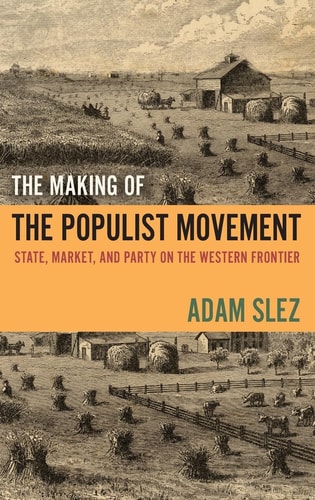
The Making of the Populist Movement: State, Market, and Party on the Western Frontier
0
0
As an Amazon Associate and affiliate partner, Menrva Books earns from qualifying purchases. Learn more
Author Description
When it comes to explaining the origins of electoral populism in the United States, we often look to the characteristics and conditions of voters, overlooking the reasons why populist candidates emerge in the first place.In The Making of the Populist Movement, Adam Slez argues that the rise of electoral populism in the American West was a strategic response to a political environment in which the configuration of positions was literally locked in place, precluding the success of new contenders or otherwise marginal competitors. Combining traditional forms of historical inquiry with innovations in network analysis and spatial statistics, he shows how the expansion of state and market drove the push for market regulation in southern Dakota, where an insurgent farmers' movement looked to third-party alternatives as a means of affecting change. In the context of western settlement, the struggle for political power was synonymous with the struggle for position in an emerging urban hierarchy. As inequities in the spatial distribution of resources became more pronounced, appeals to agrarian populism became a powerful political tool with which to wage partisan war.Offering a fresh take on the origins of electoral populism in the United States, The Making of the Populist Movement contributes to our understanding of political action by explicitly linking the evolution of the political field to the transformation of physical space through concerted action on the part of elites.
Menrva's Summary
THE THESIS
This book investigates the structural origins of electoral populism in the American West by examining how political and economic configurations constrained candidate emergence. Adam Slez, a sociologist specializing in political fields and social movements, utilizes a combination of historical archival research and quantitative methods. He argues that populism was not merely a reaction to voter sentiment, but a strategic maneuver by political actors navigating a rigid hierarchy of power and spatial resource distribution.
THE SCOPE MAP
What You Will Find
- Analysis of the political landscape in late 19th-century southern Dakota.
- Application of network analysis and spatial statistics to historical political data.
- Examination of the relationship between urban hierarchy development and partisan competition.
Scope Limits
- The study is geographically confined to the American West, specifically southern Dakota.
- The analysis focuses primarily on elite-driven political strategy rather than grassroots voter psychology.
THE AUTHORITY PERSPECTIVE
Scholars in political sociology recognize this work for its innovative integration of spatial statistics with traditional historical inquiry. Readers frequently note the academic density of the prose, which is intended for an audience familiar with institutional theory and political field analysis.
Page Count:
280
Publication Date:
2020-09-01
Publisher:
Oxford University Press
ISBN-10:
0190090502
ISBN-13:
9780190090500
Politics
History
Peoples Party US
American History
HistoryPeoples Party US
New Used & Rental Textbooks
Populism
Sociology
Political Geography
Community Tags
Similar Books