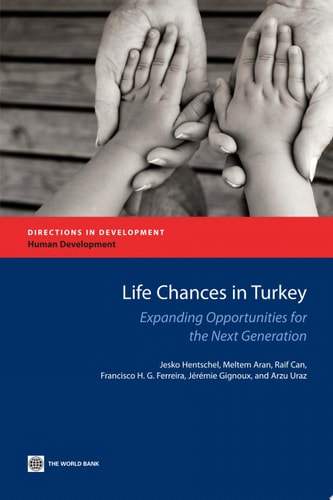
Life Chances in Turkey: Expanding Opportunities for the Next Generation
0
0
As an Amazon Associate and affiliate partner, Menrva Books earns from qualifying purchases. Learn more
Author Description
Life chances explore the state of equality of opportunities in Turkey. It builds on the concepts and ideas presented in the World Development Report 2006: equity and development. The authors assess how today's distribution of wealth and the success of children in learning to read and write are shaped by the past, by factors predetermined at birth, factors over which today's children and families have no control: one's gender, parents' and grandparents' education, region and area of birth, or mother tongue. Some of the findings are stark, especially as they pertain to how the opportunities today's children have affect the future of the country: a girl born in a remote village to a poor family and parents with primary education degrees will very likely struggle in almost every area of her development. Compared with a boy born to well-off, highly educated parents in one of the urban centers in the country's west, that girl is four times as likely to suffer from low birth weight, one-third as likely to be immunized, and ten times as likely to have her growth stunted as a result of malnutrition. Similarly she has a one-in-five chance of completing high school, whereas the boy will likely finish school and move on to college. Life chances shows how investing in early childhood education has huge payoffs, for disadvantaged children as well as social and economic development at large. This book goes beyond tradeoffs between efficiency and equity. It shows that a focus on equity, equality of opportunities, can also lead to enhanced efficiency, once the productive capabilities of all citizens are nurtured to their fullest extent regardless of the luck of the draw at birth.
Menrva's Summary
THE THESIS
This book investigates the extent to which equality of opportunity exists in Turkey and how past circumstances shape the present and future prospects of its next generation. The authors build upon the World Development Report 2006: Equity and Development to analyze how factors predetermined at birth, such as gender, parental education, region, and mother tongue, influence current distributions of wealth and educational attainment. The analysis reveals stark disparities, particularly for girls in remote, impoverished areas with less educated parents, who face significantly higher risks of poor health outcomes and lower educational achievement compared to boys from privileged urban backgrounds. The book argues that investing in early childhood education offers substantial benefits for disadvantaged children and for the nation's overall social and economic development, demonstrating that a focus on equity can enhance efficiency by nurturing the full productive capabilities of all citizens.
THE SCOPE MAP
- Analysis of equality of opportunities in Turkey.
- Application of concepts from the World Development Report 2006: Equity and Development.
- Assessment of how predetermined factors (gender, parental education, region, mother tongue) shape current life chances.
- Examination of the impact of past circumstances on children's learning and development.
- Detailed comparison of life chances for disadvantaged girls versus privileged boys.
- Evidence on the correlation between birth conditions and outcomes like low birth weight, immunization, and stunted growth.
- Projection of educational attainment, including high school completion and college prospects.
- Argument for the economic and social benefits of investing in early childhood education.
THE AUTHORITY PERSPECTIVE
The book is presented as a rigorous analysis of social and economic disparities in Turkey, drawing on established development economics frameworks. Its findings highlight significant inequalities rooted in birth circumstances, particularly affecting girls in disadvantaged regions, and underscore the critical role of early childhood education in fostering both individual potential and national development. The work aims to demonstrate that prioritizing equity in opportunity can lead to greater overall economic efficiency by unlocking the capabilities of all citizens.
Page Count:
91
Publication Date:
2010-01-01
Publisher:
World Bank
ISBN-10:
0821384007
ISBN-13:
9780821384008
Economics
Non-Fiction
Turkey
Social Science
Community Tags
Similar Books







Reader Comments
Share Your Thoughts
No comments yet. Be the first to share your thoughts!