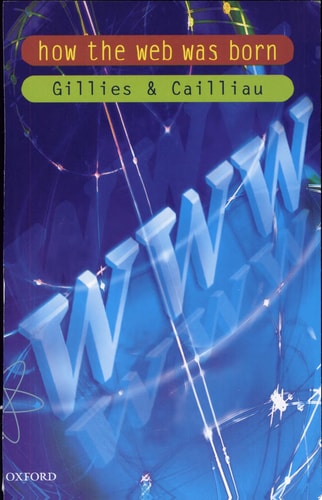
How the Web Was Born: The Story of the World Wide Web
0
0
As an Amazon Associate and affiliate partner, Menrva Books earns from qualifying purchases. Learn more
Author Description
In 1994, a computer program called the Mosaic browser transformed the Internet from an academic tool into a telecommunications revolution. Now a household name, the World Wide Web is a prominent fixture in the modern communications landscape, with tens of thousands of servers providing information to millions of users. Few people, however, realize that the Web was born at CERN, the European Laboratory for Particle Physics in Geneva, and that it was invented by an Englishman, Tim Berners-Lee.Offering its readers an unprecedented "insider's" perspective, this new book was co-written by two CERN employees--one of whom, Robert Cailliau, was among the Web's pioneers. It tells how the idea for the Web came about at CERN, how it was developed, and how it was eventually handed over at no charge for the rest of the world to use. The first book-length account of the Web's development, How the Web was Born draws upon several interviews with the key players in this amazing story. This compelling and highly topical book is certain to interest all general readers with a taste for the Web or the Internet, as well as students and teachers of computing, technology, and applied science.
Menrva's Summary
THE THESIS
This book investigates the origins and rapid evolution of the World Wide Web from its inception as an academic tool at CERN to its status as a global communications infrastructure. Authors James Gillies and Robert Cailliau, both associated with CERN, utilize their direct access to internal documentation and key personnel to reconstruct the technical and social environment of the early 1990s. The narrative argues that the Web's success was not an inevitable technological progression but the result of specific collaborative efforts and the decision to release the technology into the public domain without cost.
THE SCOPE MAP
What You Will Find
- The historical development of the Mosaic browser and its impact on internet accessibility
- The internal culture and research environment of CERN in Geneva
- Primary source accounts from Tim Berners-Lee and other early pioneers
- The transition of the Web from a specialized particle physics tool to a public utility
Scope Limits
- Technical specifications of modern web protocols developed after the mid-1990s
- Comprehensive analysis of the commercial internet boom following the initial development phase
THE AUTHORITY PERSPECTIVE
Experts and historians of technology frequently cite this work as a primary source for understanding the institutional origins of the World Wide Web. Readers often note the balance between technical detail and accessible narrative, making it a standard reference for those interested in the history of computing.
Page Count:
372
Publication Date:
2000-01-15
Publisher:
Oxford University Press
ISBN-10:
0192862073
ISBN-13:
9780192862075
Biography
Technology
computing
Science History
Internet History
World Wide Web
Community Tags
Similar Books