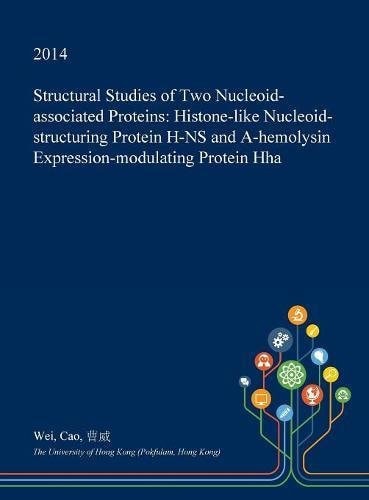
Structural Studies of Two Nucleoid-Associated Proteins: Histone-Like Nucleoid-Structuring Protein H-NS and Α-Hemolysin Expression-Modulating Protein Hha
0
0
As an Amazon Associate and affiliate partner, Menrva Books earns from qualifying purchases. Learn more
Author Description
This dissertation, "Structural Studies of Two Nucleoid-associated Proteins: Histone-like Nucleoid-structuring Protein H-NS and Α-hemolysin Expression-modulating Protein Hha" by Wei, Cao,, was obtained from The University of Hong Kong (Pokfulam, Hong Kong) and is being sold pursuant to Creative Commons: Attribution 3.0 Hong Kong License. The content of this dissertation has not been altered in any way. We have altered the formatting in order to facilitate the ease of printing and reading of the dissertation. All rights not granted by the above license are retained by the author. Abstract: In prokaryotic cells, the nucleoid contains almost all the genetic materials as well as a number of nucleoid structuring factors. The nucleoid-associated proteins (NAPs) are known to have low molecular weight and the ability to form dimer or oligomer, and most of them can bind to DNA for regulation of gene expression. The Histone-like nucleoid structuring protein H-NS, well studied as one of the NAPs, acts as a global transcriptional repressor. It has independent functional N-terminal domain for oligomerization and C-terminal domain for DNA binding, joined by a flexible linker. H-NS contributes to horizontal genes transfer and responses to environmental factors like temperature or pH, which would influence the oligomerization ability of H-NS and DNA binding. The α-hemolysin expression-modulating protein Hha is a member of the Hha-YmoA family, expressed only in Gram-negative Enterobacteriaceae as a modulator of virulence factors expression. In E. coli, the binding of Hha to H-NS can modulate the expression of α-hemolysin operon, which is essential for the H-NS-regulated gene expression. In this study, both Hha and the oligomerization domain of H-NS (H-NS64) were expressed in E. coli and the purified proteins were crystallized. The Hha crystals diffracted to 2.2 A; and the HhA/H-NS complex crystals diffracted to 1.8 A. Both structures were successfully determined by molecular
Menrva's Summary
THE THESIS
This dissertation investigates the structural characteristics of two key bacterial nucleoid-associated proteins, H-NS and Hha, to understand their roles in gene regulation and virulence. The work details the expression, purification, and crystallization of these proteins, focusing on the histone-like nucleoid-structuring protein H-NS, a global transcriptional repressor, and the α-hemolysin expression-modulating protein Hha, which interacts with H-NS to control virulence factor expression. The research aims to elucidate the molecular mechanisms underlying their DNA binding, oligomerization, and regulatory functions within prokaryotic cells, particularly in E. coli.
THE SCOPE MAP
- Structural determination of the Histone-like Nucleoid-Structuring Protein (H-NS) oligomerization domain (H-NS64).
- Structural determination of the α-hemolysin expression-modulating protein (Hha).
- Structural determination of the Hha/H-NS complex.
- Analysis of H-NS's independent N-terminal domain for oligomerization and C-terminal domain for DNA binding.
- Investigation into H-NS's role in horizontal gene transfer and environmental responses.
- Examination of Hha's modulation of virulence factors, specifically the α-hemolysin operon in E. coli.
- Crystallographic data for Hha crystals (diffracted to 2.2 Å) and Hha/H-NS complex crystals (diffracted to 1.8 Å).
THE AUTHORITY PERSPECTIVE
This dissertation presents detailed structural studies of bacterial nucleoid-associated proteins, H-NS and Hha, contributing to the understanding of prokaryotic gene regulation and virulence. The work focuses on the molecular mechanisms of DNA binding and protein-protein interactions, providing crystallographic data that elucidates the structures of these proteins and their complexes. The research is grounded in experimental biochemistry and structural biology, offering insights into how these proteins function within the bacterial nucleoid. The findings are presented in a format typical for doctoral research, suitable for specialists in molecular biology and genetics.
Page Count:
0
Publication Date:
2017-01-27
Publisher:
BiblioBazaar
ISBN-10:
1361368098
ISBN-13:
9781361368091
Science
Non-Fiction
Genetics
Biochemistry
Community Tags
Similar Books



Reader Comments
Share Your Thoughts
No comments yet. Be the first to share your thoughts!