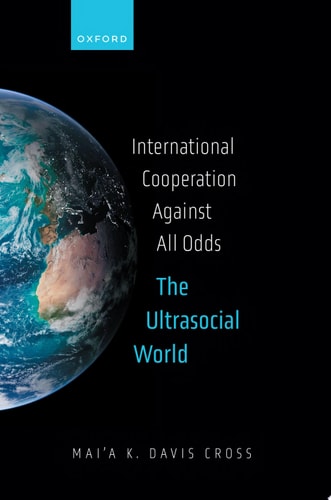
International Cooperation Against All Odds: The Ultrasocial World
0
0
As an Amazon Associate and affiliate partner, Menrva Books earns from qualifying purchases. Learn more
Author Description
International Cooperation Against All Odds: The Ultrasocial World recasts how we understand international relations through an examination of how the human evolutionary predisposition to be "ultrasocial" as a species impacts which political ideas succeed, transform, manipulate, and inspire on a global scale.At a time when pessimism about our current world order is at an all-time high, this book overturns widespread assumptions that international relations is mainly about conflict, power, and national self-interest. In the last 10-20 years, scientists have discovered that as a species, we are biologically hard-wired, soft-wired, and pre-wired to be other-regarding and cooperative. Humans are an ultrasocial species, and yet this predisposition is completely ignored in governments across the world. Political leaders, experts, and the media have cultivated a myopic vision of global conflict, feeding an obsession on crises of the moment, rather than recognizing frequent and significant breakthroughs in peaceful cooperation and overall trends in the decline of violence.This book shows how time and time again our ultrasocial predisposition has pushed us towards big ideas that inspire and bring us together around the power of possibility. Featuring original research on international cooperation in outer-space exploration, European Union integration, nuclear weapons, and climate change, among other examples, Mai'a K. Davis Cross shows ultrasociality at work in a range of contexts. Tracing the path from social neuroscience and evolutionary biology (among others) to the power of ideas to international agreements, International Cooperation Against All Odds opens up an entirely new understanding of world politics. If we recognize our nature as a species and the potential we have to work together, we can start to transform institutions, and devise policies that take advantage of this. The book ends with a roadmap to promote more international cooperation, and eventually, a more s
Menrva's Summary
THE THESIS
This book investigates how the human biological predisposition toward 'ultrasociality'—a hard-wired tendency for cooperation and other-regarding behavior—challenges traditional realist assumptions that international relations are defined solely by conflict and national self-interest. Mai'a K. Davis Cross, a scholar in international relations, synthesizes findings from social neuroscience and evolutionary biology to argue that current political institutions fail to leverage this innate human capacity. By examining the success of global cooperative efforts, she posits that recognizing our species' biological nature can lead to more effective policy-making and institutional reform.
THE SCOPE MAP
What You Will Find
- Analysis of the intersection between evolutionary biology and international political theory.
- Case studies on European Union integration, outer-space exploration, and climate change agreements.
- A proposed roadmap for institutional reform based on cooperative human behavior.
Scope Limits
- The text does not provide a comprehensive history of all international conflicts.
- It does not focus on the tactical military or economic details of specific state-level negotiations.
THE AUTHORITY PERSPECTIVE
Scholars and readers note that this work offers a distinct departure from traditional power-politics frameworks by grounding political theory in biological reality. Experts highlight the text as a provocative contribution to the field that encourages a shift in how policymakers view the potential for global cooperation.
Page Count:
320
Publication Date:
2024-01-01
Publisher:
Oxford University Press
ISBN-10:
0192873903
ISBN-13:
9780192873903
Politics
World politics
International relations
Counseling Psychology
Sociology
Evolutionary Biology
Community Tags
Similar Books