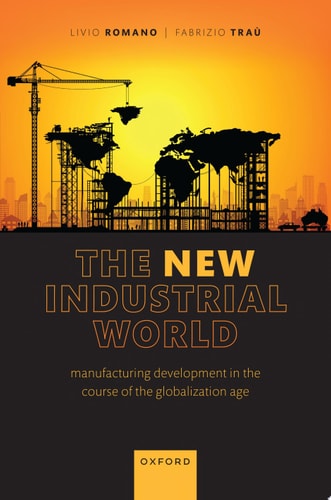
The New Industrial World: Manufacturing Development in the Course of the Globalization Age
0
0
As an Amazon Associate and affiliate partner, Menrva Books earns from qualifying purchases. Learn more
Author Description
In The New Industrial World: Manufacturing Development in the Course of the Globalization Age, Romano and Traù analyse industrial development, focussing upon the spreading of manufacturing activities beyond the boundaries of the advanced economies. They explain how this event has completely changed the nature of the relationship between the 'North' and the 'South' of the world, linking them together for the very first time on productive grounds through the development of global value chains.Providing an overall account of the reasons for the Globalization Age to rise and, in later years, to fall, the authors offer a new interpretation of the relationship between globalization and the upsurge of industrialization outside the advanced world, highlighting the role played by industrial policy in the building of manufacturing capabilities in emerging countries.Starting with the great financial crisis that hit the world at the end of the first decade of the 2000s, Romano and Traù explain how a 'new normal' has emerged, the basic features of which can be found in a slowdown of manufacturing growth rates, and in the comeback of distance as a key determinant of economic behaviour (also in light of the upsurge, in later years, of exogenous shocks such as the pandemic and Russian-Ukrainian war).
Menrva's Summary
THE THESIS
This book investigates the structural shifts in global manufacturing and the evolving economic relationship between advanced and emerging economies during the era of globalization. Authors Fabrizio Traù and Livio Romano utilize historical economic data and contemporary trade analysis to argue that the rise of global value chains fundamentally altered the North-South economic dynamic. They propose a framework for understanding the transition from rapid industrial expansion to a 'new normal' characterized by slower growth and the re-emergence of geographic distance as a critical factor in economic decision-making.
THE SCOPE MAP
What You Will Find
- Analysis of global value chain integration between advanced and emerging economies
- Examination of the impact of industrial policy on manufacturing capability building
- Assessment of economic shifts following the 2008 financial crisis and recent exogenous shocks
Scope Limits
- Does not provide a comprehensive forecast of future geopolitical trade alliances
- Does not focus on micro-level firm management strategies
THE AUTHORITY PERSPECTIVE
Experts recognize this work as a detailed synthesis of the structural changes defining modern industrial geography. Readers frequently note the academic density of the prose, which is best suited for those with a background in international economics or development studies.
Page Count:
208
Publication Date:
2024-01-01
Publisher:
Oxford University Press
ISBN-10:
0192873733
ISBN-13:
9780192873736
Economics
Manufacturing
International Trade
Globalization
Industrial Policy
Community Tags
Similar Books