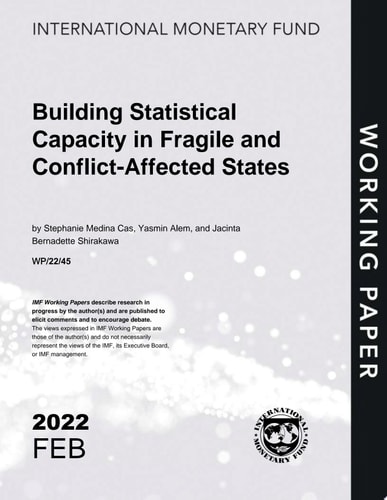
Building Statistical Capacity in Fragile and Conflict-Affected States
0
0
As an Amazon Associate and affiliate partner, Menrva Books earns from qualifying purchases. Learn more
Author Description
Based on internal data, this paper finds that the capacity development program of the IMF’s Statistics Department has prioritized technical assistance and training to fragile and conflict-affected states. These interventions have yielded only slightly weaker results in fragile states than in other states. However, capacity development is constantly needed to make up for the dissipation of progress resulting from insufficient resources that fragile and conflict-affected states allocate to the statistical function, inadequate inter-agency coordination, and the pervasive impact of shocks exogenous to the statistical system. Greater coordination with other capacity development providers and within the IMF can help partially overcome low absorptive capacity in fragile states. Statistical capacity development is more effective when it is tailored to countries’ level of fragility.
Menrva's Summary
THE THESIS
This paper investigates the effectiveness of statistical capacity development programs in fragile and conflict-affected states. The International Monetary Fund's Statistics Department has focused technical assistance and training on these challenging environments, finding that results are only slightly weaker than in more stable nations. However, progress is constantly eroded by insufficient resources, poor inter-agency coordination, and external shocks, necessitating continuous development efforts. Tailoring these interventions to a country's specific level of fragility and enhancing coordination with other providers are key to overcoming these obstacles.
THE SCOPE MAP
- Analysis of IMF's Statistics Department capacity development program interventions.
- Comparative results of technical assistance in fragile states versus other states.
- Identification of factors hindering statistical capacity progress: insufficient resources, coordination issues, and exogenous shocks.
- Recommendations for improving effectiveness through greater coordination with other providers and within the IMF.
- Emphasis on tailoring capacity development to country-specific levels of fragility.
- Data-driven findings based on internal IMF data.
THE AUTHORITY PERSPECTIVE
The analysis presented in this paper suggests that while IMF interventions show promise in fragile states, persistent challenges related to resource allocation, coordination, and external shocks limit long-term progress. The findings highlight the need for tailored approaches and enhanced collaboration among development partners to effectively build statistical capacity in these difficult contexts. The paper's focus on data-driven insights and practical recommendations positions it as a valuable resource for policymakers and practitioners involved in international development and statistical capacity building. It underscores the complex interplay between institutional capacity, resource availability, and external stability in achieving sustainable statistical development.
Page Count:
52
Publication Date:
2022-02-25
Publisher:
International Monetary Fund
ISBN-13:
9798400202742
Non-Fiction
Economics
Politics
International Development
Statistics
Public Administration
Community Tags
Similar Books