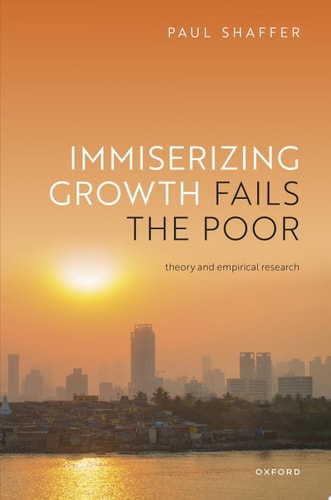
Immiserizing Growth Fails the Poor: Theory and Empirical Research
0
0
As an Amazon Associate and affiliate partner, Menrva Books earns from qualifying purchases. Learn more
Author Description
Immiserizing Growth (ig) Refers To Situations Where Economic Growth Does Not Lead To Poverty Reduction. How Should This Phenomenon Be Conceptualised? How Often, When And Where Does It Occur? Why Does It Occur? This Book Aims To Address These Three Sets Of Questions Drawing On A Wide Range Of Theoretical Perspectives And Empirical Approaches. It Presents A Conceptualisation Of Ig Which Combines The Notions Of Failed And Malevolent Inclusion, Being Bypassed And 'avoidably' Harmed By Growth, Respectively. It Addresses That Second Set Of Issues Drawing On Comparable Household Survey Data From Around 1990 Using Multiple Poverty Lines And Time Periods, And Different Measures Of Growth And Poverty. It Reviews Explanations Of Immiserizing Growth Found In A Wide Variety Of Bodies Of Thought Including The Classical Tradition Of Political Economy (mathus, Ricardo And Marx), Radical Traditions Of Scholarship, Literatures On Poverty Dynamics And Inclusive Growth And Empirical Case Studies. Eight Categories Of Processes And Mechanisms Of Ig Emerge From These Literatures Related To: I) Sectoral, Spatial Or Other Dimensions Of Growth; Ii) Poverty Traps; Iii) Public Action Or Inaction; Iv) Changes In Relative Prices Or The Terms Of Trade; V) Technological Change; Vi) Violence And Conflict; Vii) Dispossessions And Indebtedness And Viii) Environmental Degradation And 'natural' Phenomena. Part 2 Of This Manuscript Empirically Investigates Some Of These Potential Drivers Of Ig Using Econometric Analysis, Qualitative Comparative Analysis (qca) And Case Studies. The Various Chapters Of This Book Make Distinct Historical, Theoretical, Methodological And Empirical Contributions And Further Our Understanding Of A Phenomenon Which Remains Underexamined And Inadequately Understood-- Provided By Publisher.
Menrva's Summary
THE THESIS
This book investigates the phenomenon of immiserizing growth, defined as economic growth that fails to reduce poverty, by examining its conceptual foundations, frequency, and underlying causes. Paul Shaffer, an expert in development economics, synthesizes diverse theoretical traditions—ranging from classical political economy to contemporary poverty dynamics—with rigorous empirical analysis. The work provides a comprehensive framework to identify how and why growth can bypass or actively harm vulnerable populations, offering a structured approach to understanding the disconnect between macroeconomic expansion and human welfare.
THE SCOPE MAP
What You Will Find
- A conceptual framework categorizing immiserizing growth into failed and malevolent inclusion.
- Eight distinct mechanisms of immiserizing growth, including poverty traps, public policy failures, and environmental degradation.
- Empirical investigation utilizing household survey data, econometric analysis, and Qualitative Comparative Analysis (QCA).
Scope Limits
- The analysis is primarily anchored in data from around 1990, limiting its application to more recent global economic shifts.
- The study focuses on specific drivers of immiserizing growth rather than providing a universal policy manual for all economic contexts.
THE AUTHORITY PERSPECTIVE
Experts recognize this work as a significant contribution to the literature on inclusive growth and poverty dynamics. Readers frequently note the academic density of the prose and the thoroughness of the author's methodological approach to a complex economic problem.
Page Count:
208
Publication Date:
2024-05-22
Publisher:
Oxford University Press
ISBN-10:
019287005X
ISBN-13:
9780192870056
Economics
Social Science
Community Tags
Similar Books