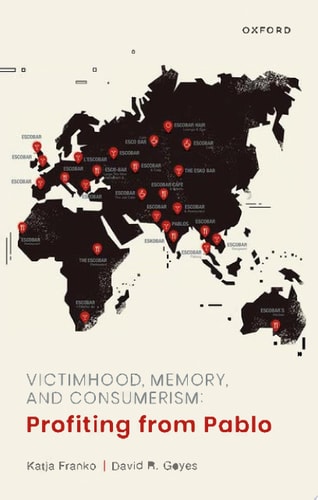
Victimhood, Memory, and Consumerism: Profiting from Pablo
0
0
As an Amazon Associate and affiliate partner, Menrva Books earns from qualifying purchases. Learn more
Author Description
Inhabitants of Medellín, Colombia, suffered from the war-like violence perpetrated by drug cartels and other actors in the 1980s and 1990s. Thousands died, including innocent civilians, judges, and journalists, many more were injured and suffered psychological trauma. Three decades later, however, transnational media companies such as Netflix have transformed the traumatic memories into entertainment while the main perpetrator, Pablo Escobar, became a recognizable brand name. Even as global audiences are captivated by Escobar's life and myth, his victims' stories fade into oblivion.Victimhood, Memory, and Consumerism: Profiting from Pablo documents the story of violence inflicted on Medellín, and critically examines the status of its victims. Drawing on unique empirical material, the book addresses the impact of commercial exploitation of the city's violent past on the victims of mass drug violence and on the present nature of the city. To demonstrate the magnitude of the profits made from the legacy of Pablo Escobar, the authors cover a range of topics. First, they discuss the appropriation by commercial forces of the city's traumatic past for the purposes of entertainment; second, they describe Escobar tours, souvenirs, and other collectibles offered by Medellín's tourism industry; and, lastly, they expose the less visible gains reaped by political and social actors who participate in the global mythmaking surrounding Escobar. Through interviews with those directly affected by drug violence, the authors show that these cultural forces have immediate symbolic and material consequences.Victimhood, Memory, and Consumerism offers a poignant critique of the role of the global market economy in the unequal distribution of narrative power among those engaged in processes of collective memory construction. The book aims, more broadly, at addressing an issue that has so far been neglected in the disciplines of criminology, international criminal justice, and victimology.
Menrva's Summary
THE THESIS
How does the commercialization of traumatic history through global media and tourism affect the victims of mass drug violence in Medellín? David R. Goyes and Katja Franko utilize empirical research and interviews with survivors to argue that the transformation of Pablo Escobar into a global brand systematically marginalizes the lived experiences of those who suffered under his regime. The authors examine the intersection of the global market economy and collective memory to reveal the symbolic and material harm caused by the commodification of violence.
THE SCOPE MAP
What You Will Find
- Analysis of the tourism industry in Medellín, including Escobar-themed tours and souvenirs.
- Examination of transnational media representations of drug violence.
- Qualitative data derived from interviews with victims of the drug cartels.
- Theoretical framework regarding narrative power and memory construction.
Scope Limits
- The study focuses specifically on the context of Medellín and does not provide a comprehensive history of the Colombian drug trade.
- The analysis does not cover the legal proceedings against cartel members in depth.
THE AUTHORITY PERSPECTIVE
Experts in criminology and victimology identify this work as a significant contribution to the study of how commercial interests shape public memory. Readers frequently note the academic rigor of the authors' critique regarding the ethics of entertainment media.
Page Count:
256
Publication Date:
2023-01-01
Publisher:
Oxford University Press
ISBN-10:
019287411X
ISBN-13:
9780192874115
History
Media Studies
Victimology
Colombia
Sociology
Criminology
Community Tags
Similar Books