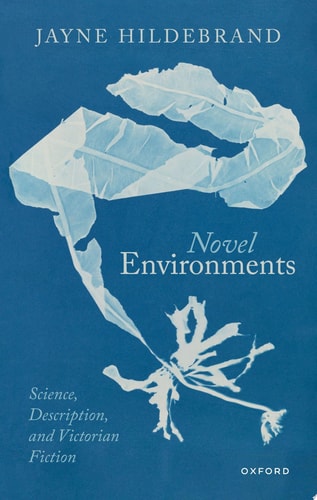
Novel Environments: Science, Description, and Victorian Fiction
0
0
As an Amazon Associate and affiliate partner, Menrva Books earns from qualifying purchases. Learn more
Author Description
The environment concept has shaped humanity's relationship to the natural world and has drawn attention to the effects of human actions on our natural surroundings. But when did we learn that we live in an environment? While scholars have often located the emergence of the environment concept in twentieth-century ecological and political thought, Novel Environments: Science, Description, and Victorian Fiction reconstructs a longer―and a specifically literary―history. It was in the descriptive worldmaking of the Victorian novel that the environment was first transformed from an abstraction into a vivid object of imagination and feeling. Engaging the scientific theories of their contemporaries, Mary Russell Mitford, George Eliot, Thomas Hardy, and Robert Louis Stevenson turned to detailed description―from gardens and landscapes to weather and atmospheres-to model interactions between life and its surroundings. Far from merely furnishing static background, the descriptive apparatus of the Victorian novel imagined the nonhuman environment as dynamically involved with human action, feeling, and development.In making this argument, Novel Environments recovers the scientific vocabulary the Victorians used to name the surroundings of living organisms. The word "environment" dominates our own way of speaking about the nonhuman world, but nineteenth-century scientific writers and novelists availed themselves of a richer conceptual lexicon, which included "environment" along with less familiar concepts such as "milieu," "medium," and "circumstance." Jayne Hildebrand traces the development of Victorian environmental thought from the earliest theorization of physical surroundings as a dynamic influence in the life sciences, through the idea of a singular "medium" in mid-century organicism, to the conception of the planet as an environmental system at the fin-de-siècle. By showing how novelistic description helped to produce the modern environment concept, Hildebrand sheds new li
Menrva's Summary
THE THESIS
This book investigates the historical origins of the modern environment concept by arguing that Victorian novelists, rather than twentieth-century ecologists, first transformed the environment into a vivid object of imagination through descriptive worldmaking. Jayne Hildebrand, a scholar of Victorian literature, utilizes a synthesis of nineteenth-century scientific discourse and literary analysis to demonstrate how authors like George Eliot and Thomas Hardy modeled the interaction between human life and its surroundings. By examining the shift from abstract surroundings to dynamic environmental systems, the author posits that the descriptive apparatus of the novel was a primary site for the development of modern ecological thought.
THE SCOPE MAP
What You Will Find
- Analysis of the scientific lexicon including terms like milieu, medium, and circumstance.
- Examination of descriptive techniques in works by Mary Russell Mitford, George Eliot, Thomas Hardy, and Robert Louis Stevenson.
- A chronological tracing of environmental thought from early life sciences to fin-de-siècle organicism.
Scope Limits
- The study focuses primarily on British Victorian literature and does not extend into contemporary climate fiction or global environmental literature.
THE AUTHORITY PERSPECTIVE
Scholars in the field of Victorian studies and environmental humanities recognize this work as a significant contribution to the history of ideas. Readers frequently note the academic density of the prose and the author's precise integration of scientific history with literary analysis.
Page Count:
224
Publication Date:
2023-01-01
Publisher:
Oxford University Press
ISBN-10:
0192888471
ISBN-13:
9780192888471
English literature
Victorian
Science History
Literary theory
Literary Criticism