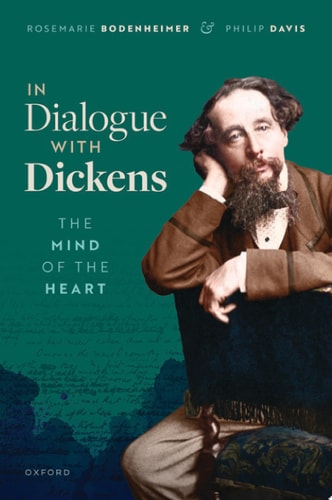
In Dialogue with Dickens: The Mind of the Heart
0
0
As an Amazon Associate and affiliate partner, Menrva Books earns from qualifying purchases. Learn more
Author Description
Written in the form of a back-and-forth dialogue between the two authors, this book is about the relationship between feeling and thinking in Dickens's novels. It presents Dickens as a psychological thinker, whose generative thought may be conscious, unconscious, half-conscious, or in transit between one state and another. This Dickens is always in live process, improvizing from one monthly number to the next, subtly revizing as he goes, shifting moods, tenses, and tones from one paragraph or sentence to the next, as what he writes sparks off what he suddenly, newly, thinks.The chapters approach this inquiry through close readings of chosen passages, including studies of telling revisions in Dickens's manuscripts that reveal the power of his deepened second thoughts. They also draw on selected moments from his personal letters and prefaces when these more casual writings prove to be sketches or rehearsals for thoughts and feelings that achieve new life when they are transformed into fiction. The book concentrates on four novels of his great middle period: Dombey and Son, David Copperfield, Bleak House, and Little Dorrit, while making excursions into earlier and later Dickens novels, notably A Tale of Two Cities and Our Mutual Friend. The experiment of intense but informal conversation between the authors also models the relationship between feeling and thinking in the act of reading and responding to powerful moves in fiction.
Menrva's Summary
THE THESIS
This book investigates the intersection of feeling and thinking within the novels of Charles Dickens, positing him as a sophisticated psychological thinker. The authors, Philip J. Davis and Rosemarie Bodenheimer, utilize a collaborative dialogue format to explore how Dickens’s creative process functioned in real-time. By examining the transition between conscious and unconscious thought, they argue that Dickens’s writing was an improvisational act that evolved through constant revision and shifting narrative tones.
THE SCOPE MAP
What You Will Find
- Close readings of selected passages from Dickens's middle-period novels.
- Analysis of manuscript revisions to track the author's evolving thought process.
- Comparative study of personal letters and prefaces alongside fictional output.
- A methodological framework based on conversational inquiry between two scholars.
Scope Limits
- The analysis focuses primarily on four specific novels: Dombey and Son, David Copperfield, Bleak House, and Little Dorrit.
- The text does not provide a comprehensive biography of Dickens or a complete survey of his entire bibliography.
THE AUTHORITY PERSPECTIVE
Scholars and readers often note the unique structural approach of this work, which mirrors the improvisational nature of Dickens's own writing process. Experts highlight the book as a valuable contribution to the study of Victorian literary psychology and the mechanics of creative composition.
Page Count:
256
Publication Date:
2024-01-01
Publisher:
Oxford University Press
ISBN-10:
0192886746
ISBN-13:
9780192886743
Non-Fiction
Psychology
Biography
Literary Criticism
English literature
Victorian
Community Tags
Similar Books