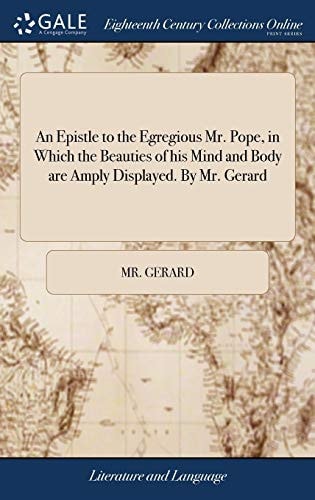
An Epistle to the Egregious Mr. Pope, in Which the Beauties of his Mind and Body are Amply Displayed
0
0
As an Amazon Associate and affiliate partner, Menrva Books earns from qualifying purchases. Learn more
Author Description
The 18th century was a wealth of knowledge, exploration and rapidly growing technology and expanding record-keeping made possible by advances in the printing press. In its determination to preserve the century of revolution, Gale initiated a revolution of its own: digitization of epic proportions to preserve these invaluable works in the largest archive of its kind. Now for the first time these high-quality digital copies of original 18th century manuscripts are available in print, making them highly accessible to libraries, undergraduate students, and independent scholars. Western literary study flows out of eighteenth-century works by Alexander Pope, Daniel Defoe, Henry Fielding, Frances Burney, Denis Diderot, Johann Gottfried Herder, Johann Wolfgang von Goethe, and others. Experience the birth of the modern novel, or compare the development of language using dictionaries and grammar discourses. ++++ The below data was compiled from various identification fields in the bibliographic record of this title. This data is provided as an additional tool in helping to insure edition identification: ++++ Harvard University Houghton Library N016740 Mr. Gerard is a pseudonym; sometimes attributed to Eustace Budgell. Verse. London: printed for the author; and sold by M. Harris, 1734. 17,[1]p.; 2°
Menrva's Summary
THE PULSE
A satirical poem directly addresses Alexander Pope, aiming to critique his character and intellect. The work, presented as an epistle, purports to expose the perceived flaws in both Pope's mind and physical being. Written in verse, it engages with the literary and social landscape of 18th-century London, a period marked by intellectual ferment and burgeoning print culture. The author, identified only as 'Mr. Gerard' (though sometimes attributed to Eustace Budgell), uses the form of a direct address to Pope to deliver their critique.
INSIDE THE PAGES
- Verse form characteristic of 18th-century poetry.
- Direct address to a prominent literary figure, Alexander Pope.
- Satirical tone intended to critique.
- Exploration of the 'beauties' of mind and body, likely with ironic intent.
- Published in London in 1734.
- Attributed by some sources to Eustace Budgell.
- Presented as an 'epistle', a form of letter in verse.
THE COLLECTIVE ECHO
The Epistle to the Egregious Mr. Pope presents a direct, critical engagement with Alexander Pope's public persona and work. The poem's structure as an epistle, a common form for literary discourse and personal address in the 18th century, frames its satirical intent. Its publication in 1734 places it within a period of intense literary debate and the rise of print culture, where such direct critiques were both possible and impactful. The attribution to Eustace Budgell, if correct, suggests a connection to contemporary intellectual circles and potential rivalries.
Page Count:
20
Publication Date:
2018-04-22
Publisher:
Gale ECCO, Print Editions
ISBN-10:
1385217987
ISBN-13:
9781385217986
Fiction
Poetry
Literary Criticism
Community Tags
Similar Books