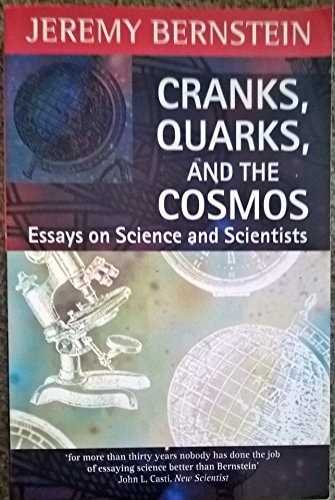
Cranks, Quarks, and the Cosmos: Writings on Science
0
0
As an Amazon Associate and affiliate partner, Menrva Books earns from qualifying purchases. Learn more
Author Description
Asking "How can we be sure that Albert Einstein was not a crank?", this book looks at the history of science from a general perspective. It includes an autobiographical account of how the author became science writer for the "New Yorker", and a series of profiles of famous scientists from Einstein, Neils Bohr and Alan Turing to Primo Levi, Edwin Land and Sophia Kovalevsky.
Menrva's Summary
THE THESIS
This collection investigates the boundary between legitimate scientific inquiry and fringe pseudoscience while examining the human lives behind major discoveries. Jeremy Bernstein, a physicist and long-time contributor to The New Yorker, utilizes his dual background in theoretical physics and journalism to synthesize complex historical narratives. He presents a framework that evaluates scientific credibility through the lens of personal character, historical context, and the rigorous demands of the scientific method.
THE SCOPE MAP
What You Will Find
- Biographical profiles of figures including Albert Einstein, Niels Bohr, Alan Turing, Primo Levi, Edwin Land, and Sophia Kovalevsky.
- An autobiographical account of the author's transition from academic physicist to professional science writer.
- Critical analysis of the criteria used to distinguish scientific genius from fringe 'crank' theories.
Scope Limits
- The text does not provide a comprehensive technical manual for the scientific theories discussed.
- It does not offer an exhaustive history of all scientific disciplines, focusing instead on specific individuals and anecdotes.
THE AUTHORITY PERSPECTIVE
Readers frequently note the accessible yet intellectually rigorous nature of Bernstein's prose, which bridges the gap between technical physics and general interest biography. Experts highlight this as a valuable collection for those interested in the history of 20th-century science and the evolution of science communication.
Page Count:
220
Publication Date:
1997-01-01
Publisher:
Oxford Univ Pr
ISBN-10:
0192880438
ISBN-13:
9780192880437
Biography
Science
Science History
Essays
Physics
Community Tags
Similar Books