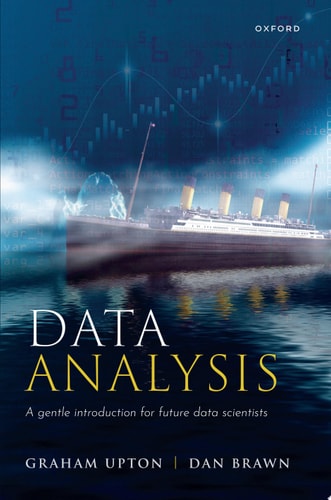
Data Analysis: A Gentle Introduction for Future Data Scientists
0
0
As an Amazon Associate and affiliate partner, Menrva Books earns from qualifying purchases. Learn more
Author Description
Data analysis has been a hot topic for a number of years, and many future data scientists have backgrounds that are relatively light in mathematics. This slim volume provides a very approachable guide to the techniques of the subject, designed with such people in mind. Formulae are kept to a minimum, but the book's scope is broad, introducing the basic ideas of probability and statistics and more advanced techniques such as generalised linear models, classification using logistic regression, and support-vector machines.An essential feature of the book is that it does not tie to any particular software. The methods introduced in this book could also be implemented using any other statistical software and applying any major statistical package. Academically, the book amounts to a first course, practical for those at the undergraduate level, either as part of a mathematics/statistics degree or as a data-oriented option for a non-mathematics degree.The book appeals to would-be data scientists who may be formula shy. However, it could also be a relevant purchase for statisticians and mathematicians, for whom data science is a new departure, overall appealing to any computer-literate reader with data to analyse.
Menrva's Summary
THE THESIS
How can individuals with limited mathematical backgrounds effectively master the foundational techniques of data science? The authors, Dan Brawn and Graham Upton, address the barrier to entry for aspiring data scientists by providing a conceptual framework that prioritizes intuitive understanding over complex mathematical notation. By focusing on the logic behind statistical methods rather than rote memorization of formulae, the text serves as a bridge for students and professionals transitioning into data-oriented roles.
THE SCOPE MAP
What You Will Find
- Fundamental concepts of probability and statistics
- Methodologies for generalised linear models and logistic regression
- Introduction to support-vector machines
- Software-agnostic implementation strategies
Scope Limits
- Does not provide deep mathematical proofs or derivations
- Does not offer tutorials for specific software packages like R or Python
THE AUTHORITY PERSPECTIVE
Experts identify this text as a highly accessible entry point for undergraduate students and professionals who lack a formal background in advanced mathematics. Readers frequently note the clarity of the prose and the authors' success in demystifying complex statistical concepts for a broad, computer-literate audience.
Page Count:
160
Publication Date:
2023-11-28
Publisher:
Oxford University Press
ISBN-10:
0192885774
ISBN-13:
9780192885777
Statistics
Computer Science
Data Science
Education
Mathematics
Community Tags
Similar Books