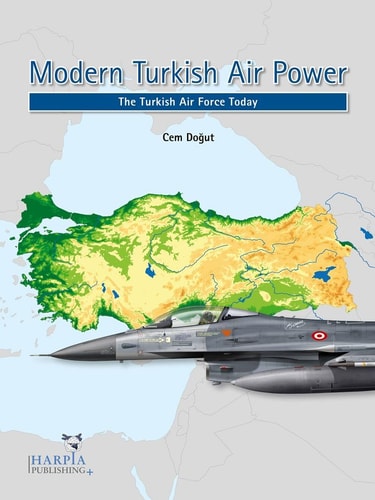
Modern Turkish Air Power: The Turkish Air Force Today
0
0
As an Amazon Associate and affiliate partner, Menrva Books earns from qualifying purchases. Learn more
Author Description
Harpia Publishing presents an in-depth look at the Turkish Air Force focusing on the varied manned aircraft and unmanned aerial vehicles (UAVs) currently in service, its structure, units and markings. This book also provides a perspective on regional threats from Turkey’s point of view, including its perspectives on Syria, north Africa and the wider Mediterranean region. Also included is a study of Turkey’s rapidly developing indigenous aircraft industry, which is now a growing global force. The development of the Turkish Air Force throughout the 20th century is charted, aided by organizational charts and maps. Not to be forgotten are the important but sometimes-overlooked aspects, namely the air force’s training syllabus and the aircraft ordnance that it uses. With roots that are almost as old as aviation itself, the Turkish Air Force was founded in 1911. Fast forward to the start of the Cold War and in 1952 Turkey became a member of the North Atlantic Treaty Organization (NATO), leading to rapid changes in terms of capability and configuration. Deployed in NATO’s southeast region, the Turkish Air Force grew rapidly to face off the Soviet threat and, in the process, adapted to the jet age. In the early post-war years, it was equipped with mainly second-hand aircraft, from the United States and other allied countries, but the years that followed saw significant purchases of new aircraft. After establishing an indigenous aviation industry, Turkey began to produce its own aircraft. Here, recent developments have included a range of UAVs, followed by an indigenous fighter design, known as TF-X, further strengthening Turkey’s position as a regional power. All these aircraft and their armaments are examined in detail in Modern Turkish Air Power, with a particular focus on indigenous designs, as well as the Turkish Air Force’s overall organization and ongoing modernization process. The result is a unique in-depth look
Menrva's Summary
THE THESIS
This book examines the current state and historical development of the Turkish Air Force, detailing its aircraft, organizational structure, and strategic outlook. The work provides an in-depth analysis of both manned and unmanned aerial vehicles in service, alongside a study of Turkey's burgeoning indigenous aircraft industry. It contextualizes the air force's capabilities within regional threats and Turkey's geopolitical perspectives, particularly concerning Syria, North Africa, and the Mediterranean. The narrative traces the force's evolution from its founding in 1911 through its integration into NATO and adaptation to the jet age, culminating in its current modernization efforts and indigenous fighter design.
THE SCOPE MAP
- Detailed overview of manned aircraft and unmanned aerial vehicles (UAVs) currently in service.
- Analysis of the Turkish Air Force's structure, units, and aircraft markings.
- Perspective on regional threats from Turkey's viewpoint, including Syria, North Africa, and the Mediterranean.
- Study of Turkey's rapidly developing indigenous aircraft industry and its global impact.
- Historical charting of the Turkish Air Force's development throughout the 20th century, with organizational charts and maps.
- Examination of the air force's training syllabus and aircraft ordnance.
- Discussion of the impact of NATO membership and adaptation to the jet age.
- Focus on indigenous designs, including the TF-X fighter project, and the overall modernization process.
THE AUTHORITY PERSPECTIVE
The book offers a comprehensive look at the Turkish Air Force, detailing its modern capabilities and historical trajectory. It is presented as an in-depth analysis for those interested in military aviation and regional geopolitics. The work aims to provide a unique perspective on Turkey's growing role as a regional power, supported by detailed examinations of its aircraft and industry. The inclusion of historical context and strategic outlook suggests a resource for understanding contemporary defense dynamics.
Page Count:
256
Publication Date:
2024-01-28
Publisher:
Harpia Publishing, LLC
ISBN-10:
1950394131
ISBN-13:
9781950394135
Non-Fiction
Politics
History
Military History
Geopolitics
Current Affairs
Aviation
Community Tags
Similar Books