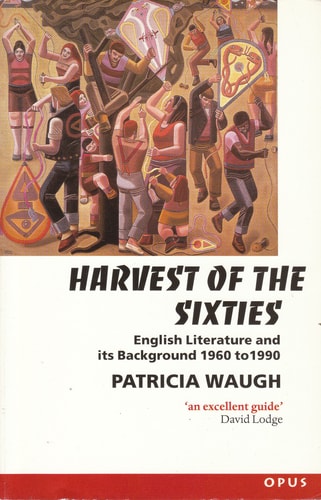
Harvest of the Sixties: English Literature and Its Background 1960 to 1990
0
0
As an Amazon Associate and affiliate partner, Menrva Books earns from qualifying purchases. Learn more
Author Description
This engaging book sets English literature since 1960 in its political and cultural context. From the end of empire in the sixties, through the attempts in the 1970s to maintain a "common culture" through education, good literature, and state subsidies for the Arts, to the 1980s when there was a shift toward the acknowledgement of a multiplicity of cultures, this was a period of considerable change and development. Waugh looks at the effects of the fragmentation of English culture and examines the new and varied voices that grew up as a result of this proliferation of cultures.
Menrva's Summary
THE THESIS
This work investigates how the shifting political and cultural landscape of Britain between 1960 and 1990 fundamentally reshaped the production and reception of English literature. Patricia Waugh, a scholar of literary theory and modernism, utilizes a historical-materialist framework to analyze the transition from post-imperial homogeneity to the fragmented, pluralistic cultural environment of the late twentieth century. She argues that literature during this period functioned as both a reflection of and a reaction to state-sponsored cultural policies and the decline of traditional social structures.
THE SCOPE MAP
What You Will Find
- Analysis of the post-imperial cultural climate of the 1960s.
- Examination of state-subsidized arts and education initiatives in the 1970s.
- Discussion of the rise of multiculturalism and cultural fragmentation in the 1980s.
- Critical evaluation of the relationship between political shifts and literary output.
Scope Limits
- The text focuses primarily on British literature and does not provide an exhaustive survey of global English-language literature.
- It does not offer a comprehensive bibliography of every author active during these three decades.
THE AUTHORITY PERSPECTIVE
Scholars and students of literature frequently cite this text as a foundational resource for understanding the intersection of British social history and literary development. Experts highlight the clarity of Waugh's prose in navigating complex cultural shifts, making it a standard reference for those studying the evolution of the contemporary literary canon.
Page Count:
256
Publication Date:
1995-09-07
Publisher:
Oxford University Press
ISBN-10:
0192892266
ISBN-13:
9780192892263
Literary Criticism
English literature
Social History
Great Britain
Cultural History
Literature History
British literature
Community Tags
Similar Books