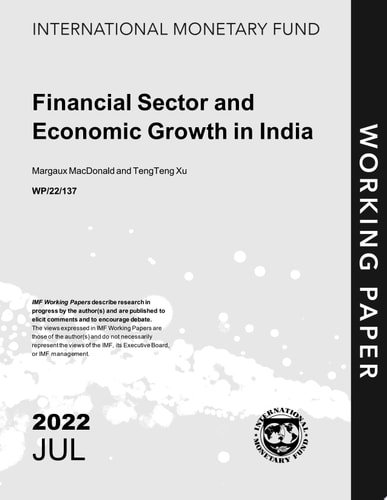
Financial Sector and Economic Growth in India
0
0
As an Amazon Associate and affiliate partner, Menrva Books earns from qualifying purchases. Learn more
Author Description
India’s financial sector has faced many challenges in recent decades, with a large, negative, and persistent credit to GDP gap since 2012. We examine how cyclical financial conditions affect GDP growth using a growth-at-risk (GaR) approach and analyze the link between bank balance sheets, credit growth, and long-term growth using bank-level panel regressions for both public and private banks. We find that on a cyclical basis, a negative shock to credit or a rise in macro vulnerability all shift the distribution of growth to the left, with lower expected growth and higher negative tail risks; over the long term, the results indicate that higher credit growth, arising from better capitalized banks with lower NPLs, is associated with higher GDP growth.
Menrva's Summary
THE THESIS
This book investigates the complex relationship between India's financial sector and its economic growth, particularly in light of persistent challenges like the credit-to-GDP gap. The authors employ a growth-at-risk (GaR) approach to assess how cyclical financial conditions impact GDP growth and utilize bank-level panel regressions to analyze the connection between bank balance sheets, credit expansion, and long-term economic expansion, differentiating between public and private banks. Their findings highlight that negative shocks to credit and increased macro vulnerability lead to reduced expected growth and heightened tail risks, while sustained credit growth, supported by well-capitalized banks with fewer non-performing loans, correlates with higher GDP growth.
THE SCOPE MAP
- Analysis of India's financial sector challenges since 2012, focusing on the credit-to-GDP gap.
- Application of a growth-at-risk (GaR) approach to model cyclical financial conditions' impact on GDP growth.
- Examination of the link between bank balance sheets, credit growth, and long-term economic expansion.
- Use of bank-level panel regressions for both public and private banks in India.
- Identification of how negative credit shocks and increased macro vulnerability affect growth distribution and tail risks.
- Empirical evidence linking higher credit growth from better-capitalized banks with lower NPLs to increased GDP growth.
THE AUTHORITY PERSPECTIVE
The analysis presented in this book offers a data-driven perspective on the critical interplay between financial sector health and economic expansion in India. By utilizing sophisticated econometric models, the authors provide insights into the cyclical and long-term dynamics that shape the nation's growth trajectory. The findings underscore the importance of robust bank capitalization and effective non-performing loan management for fostering sustainable economic development. This work is likely to be of significant interest to economists, policymakers, and financial analysts focused on emerging markets.
Page Count:
29
Publication Date:
2022-07-08
Publisher:
International Monetary Fund
ISBN-13:
9798400216404
Economics
Non-Fiction
Finance
India
Community Tags
Similar Books