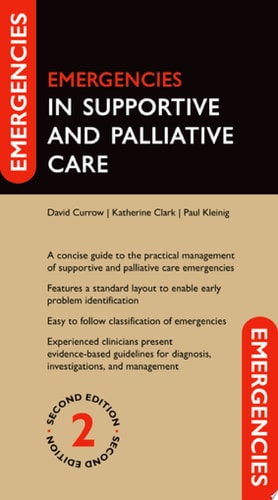
Emergencies in Supportive and Palliative Care
0
0
As an Amazon Associate and affiliate partner, Menrva Books earns from qualifying purchases. Learn more
Author Description
Fully revised according to up-to-date clinical guidance, this second edition provides a practical, accessible guide to emergency situations encountered in the practice of supportive and palliative care. Designed for rapid use, it addresses the immediate clinical challenges while more definitive measures are being put in place.Structured around frequently encountered symptoms, the book is split into two sections. The first section explores how patients with life-limiting illnesses such as cancer, AIDS, and end-stage organ failure normally present, and looks at the reversibility of their condition. The second section provides a detailed approach to specific clinical conditions, and is for use once the clinical diagnosis has been reached on the basis of the presenting symptoms. An improved order to the table of contents for this edition matches clinical practice.Guiding the decision-making process is an understanding of where the patient is on their disease trajectory. The book uses three categories (terminal, deteriorating, and stable), which consider how the patient's needs are changing as their disease progresses. A brand new chapter 'Care at the end of life' outlines good clinical care for the last hours days of life when the diagnosis of dying has been actively made.The book provides trainees in palliative medicine, nurses, family doctors, and other allied health professionals with a pocket guide to the emergency care of people requiring supportive and palliative care, and it complements and cross-refers to the Oxford Handbook of Palliative Care.
Menrva's Summary
THE THESIS
This text investigates the clinical management of acute emergency situations specifically within the context of supportive and palliative care for patients with life-limiting illnesses. The authors, including David C. Currow, Paul Kleinig, and Katherine Clark, utilize current clinical guidelines to establish a framework for rapid decision-making. By categorizing patients based on their disease trajectory—terminal, deteriorating, or stable—the book provides a structured approach to addressing immediate symptoms while considering the broader goals of care.
THE SCOPE MAP
What You Will Find
- Clinical protocols for managing emergencies in cancer, AIDS, and end-stage organ failure.
- A two-part organizational structure focusing on symptom presentation and specific diagnostic approaches.
- A dedicated chapter on care during the final hours and days of life.
Scope Limits
- The text does not serve as a comprehensive textbook on general medicine or primary palliative care theory.
- It is intended as a rapid-reference pocket guide rather than an exhaustive clinical manual.
THE AUTHORITY PERSPECTIVE
Experts and practitioners frequently cite this work as a practical, high-utility resource for trainees and allied health professionals working in palliative settings. Readers note that the book's alignment with clinical practice and its cross-referencing with the Oxford Handbook of Palliative Care make it a reliable tool for bedside decision-making.
Page Count:
336
Publication Date:
2024-01-01
Publisher:
Oxford University Press
ISBN-10:
0192898337
ISBN-13:
9780192898333
Medicine
Emergency medicine
Nursing
Medical
Clinical Reference
Community Tags
Other Editions(2)
Similar Books