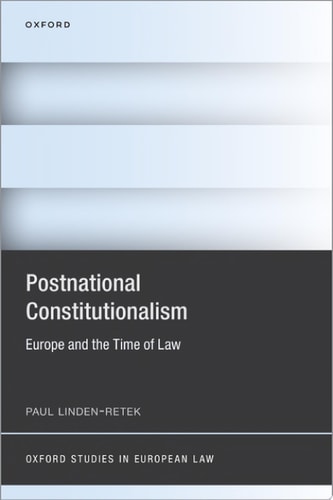
Postnational Constitutionalism: Europe and the Time of Law
0
0
As an Amazon Associate and affiliate partner, Menrva Books earns from qualifying purchases. Learn more
Author Description
At a time when the integration of the European Union's peoples through the rule of law is faltering, this book develops a critical theory of postnational constitutionalism. Today, widely held conceptions of EU law continue to mislead citizens about the nature of political identity, sovereignty, and agency. They lose sight of a critical idea on which post-nationalism depends-that constitutional self-authorship is narrative, and the polity is a subject whose identity, history, and legacy are still in formation. Absent this vision, EU law reproduces crises of legitimacy: the depoliticization of public life; emergency rule by executive decree; a collapse of solidarity; and the rise of nativist movements. The book diagnoses this impasse as the product of a problem familiar to modernity: reification—a process in which social and historical relationships are misattributed as timeless relations among things. Reification's shrinking of social dilemmas, moral principles, and political action to narrow perceptions of the present explains law's role in perpetuating crisis. But this diagnosis also points to a remedy. It suggests that to sustain the emancipatory potential of EU constitutionalism we must recover law's relationship to time. Postnational Constitutionalism: Europe and the Time of Law proposes a temporally-attuned constitutional theory with principles of anti-reification, narrative interpretation, and non-sovereign agency at its centre. These principles reimagine essential domains of constitutional order: social integration, constitutional adjudication, and constituent power. Spanning various bodies of EU jurisprudence, the book devotes particular attention to migration and asylum—struggles where questions of solidarity, law, and belonging are most generative and acute.
Menrva's Summary
THE THESIS
How can the European Union overcome its current crisis of legitimacy by re-evaluating the relationship between law and time? Paul Linden-Retek, a scholar of law and political theory, argues that the EU's current constitutional framework suffers from reification, which obscures the narrative nature of political identity. By proposing a temporally-attuned theory of constitutionalism, the author seeks to restore the emancipatory potential of EU law through principles of anti-reification and non-sovereign agency.
THE SCOPE MAP
What You Will Find
- A critical analysis of EU jurisprudence regarding migration and asylum policies.
- A theoretical framework for narrative interpretation and constitutional self-authorship.
- An examination of the sociological concept of reification within modern legal systems.
Scope Limits
- The text does not provide a comprehensive history of all EU treaties or institutional structures.
- It focuses primarily on theoretical and normative constitutional questions rather than practical administrative law.
THE AUTHORITY PERSPECTIVE
Legal scholars and political theorists frequently note the high level of academic density and philosophical rigor present in this work. Experts highlight this as a significant contribution to the ongoing discourse regarding the future of European integration and the legitimacy of postnational legal orders.
Page Count:
342
Publication Date:
2023-01-01
Publisher:
OUP Oxford
ISBN-10:
0192899201
ISBN-13:
9780192899200
Constitutional Law
Sociology of Law
Political Theory
Professional Career & Trade
Law
European Union
Community Tags
Similar Books