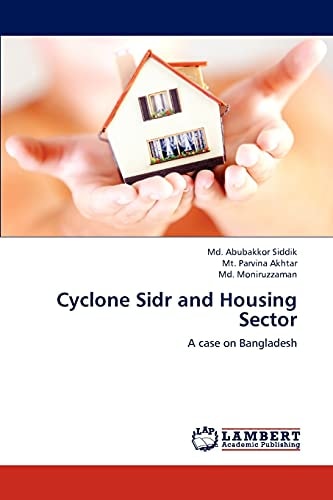
Cyclone Sidr and Housing Sector
0
0
As an Amazon Associate and affiliate partner, Menrva Books earns from qualifying purchases. Learn more
Author Description
On 15 November 2007, super cyclone Sidr hit in Bangladesh with wind speed 240 km/h (category 4) and storm surges up to 6 meters in some areas caused 3406 deaths and affected 2.3 million households of one million were severely affected. Total damaged value was 79904 million BDT over the country including housing sector 57915 million BDT. The main objectives of the study were to find out the damage nature of family shelters due to cyclone Sidr; and assessing the recovery initiatives of family shelters. Data and information are mainly primary sources which have collected from 167 affected households of Sarankhola upazila Bagerhat. This study reveals that cyclonic wind pressure and associated storm surge was the main cause of houses collapse. Total 500 houses were damaged of 167 households. Government initiatives are negligible while NGOs and INGOs are the main players of recovering the family shelters. About 97.17 percent of severely affected families have acquired main houses from relevant organizations but all the reconstructing houses are not so strong because of their materials. After all, the inhabitants of the study area are happy because they have a roof over their head.
Menrva's Summary
THE THESIS
This study investigates the damage and recovery of family shelters in Bangladesh following the catastrophic Super Cyclone Sidr in 2007. The research focuses on the impact of extreme weather events on housing, specifically examining the nature of damage to family shelters and the effectiveness of recovery initiatives. Drawing on primary data collected from 167 affected households in Sarankhola upazila, Bagerhat, the study identifies cyclonic wind pressure and storm surges as the primary causes of house collapse, with a significant number of structures being damaged. The analysis also highlights the roles of government, NGOs, and INGOs in the recovery process, noting that while many families have received new housing, material quality remains a concern.
THE SCOPE MAP
- Analysis of damage to family shelters caused by Super Cyclone Sidr.
- Assessment of recovery initiatives for family shelters post-cyclone.
- Identification of primary causes of house collapse: cyclonic wind pressure and storm surges.
- Data collected from 167 affected households in Sarankhola upazila, Bagerhat.
- Quantification of housing damage: 500 houses damaged out of 167 households.
- Evaluation of the roles of government, NGOs, and INGOs in shelter recovery.
- Assessment of the quality and materials of reconstructed houses.
- Inhabitants' satisfaction with having shelter, despite material concerns.
THE AUTHORITY PERSPECTIVE
This study provides a detailed account of the devastation wrought by Cyclone Sidr on Bangladesh's housing sector and the subsequent recovery efforts. The research highlights the critical need for robust housing solutions that can withstand extreme weather events, emphasizing the significant impact of both natural forces and material choices on structural integrity. The findings underscore the disparity in recovery support, with NGOs and INGOs playing a more substantial role than government initiatives. Ultimately, the work conveys a sense of resilience among the affected population, who prioritize having a roof over their heads.
Page Count:
164
Publication Date:
2012-01-01
Publisher:
Lap Lambert Academic Publishing GmbH KG
ISBN-10:
3659283312
ISBN-13:
9783659283314
Non-Fiction
Housing
Social Science
Bangladesh
Community Tags
Similar Books