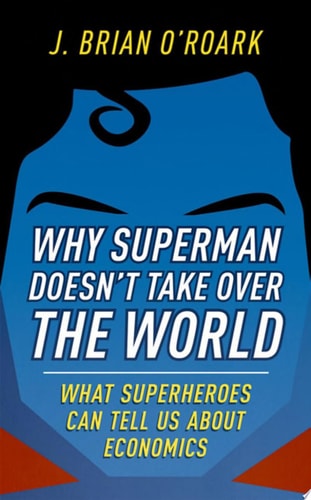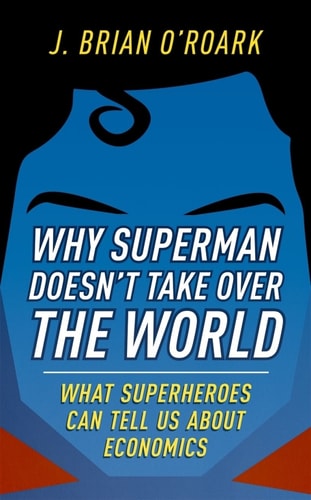
Why Superman Doesn't Take Over the World: What Superheroes Can Tell Us About Economics
0
0
As an Amazon Associate and affiliate partner, Menrva Books earns from qualifying purchases. Learn more
Author Description
Why do heroes fight each other? Why do villains keep trying even though they almost never win? Why don't heroes simply take over the world? Economics and comics may seem to be a world apart. But in the hands of economics professor and comic book hero aficionado Brian O’Roark, the two form a powerful alliance. With brilliant deadpan enthusiasm he shows how the travails of superheroes can explain the building blocks of economics, and how economics explains the mysteries of superhero behavior. Spider-Man's existential doubts revolve around opportunity costs; Wonder Woman doesn't have a sidekick because she has a comparative advantage; game theory sheds light on the battle between Captain America and Iron Man; the Joker keeps committing crimes because of the Peltzman effect; and utility curves help us decide who is the greatest superhero of all. Why Superman Doesn't Take Over the World probes the motivations of our favorite heroes, and reveals that the characters in the comics may have powers we dont, but they are still beholden to the laws of economics.
Menrva's Summary
THE THESIS
This book investigates the intersection of comic book narratives and economic theory to explain why superheroes and villains behave the way they do. Author J. Brian O’Roark, an economics professor and comic book enthusiast, utilizes the actions of iconic characters to illustrate foundational economic principles. By applying academic frameworks to fictional scenarios, he argues that even beings with superhuman abilities remain constrained by the fundamental laws of scarcity, incentives, and rational choice.
THE SCOPE MAP
What You Will Find
- Analysis of opportunity costs through the lens of Spider-Man
- Application of comparative advantage to Wonder Woman
- Use of game theory to explain conflicts like the Civil War
- Examination of the Peltzman effect regarding the Joker
- Utility curve modeling for superhero evaluation
Scope Limits
- The book does not provide a comprehensive history of comic book publishing
- It does not offer a technical textbook approach to advanced macroeconomics
THE AUTHORITY PERSPECTIVE
Readers frequently note that the prose is accessible and engaging, making complex economic concepts approachable for non-specialists. Experts highlight this work as a creative pedagogical tool that successfully bridges the gap between pop culture and academic theory.
Page Count:
211
Publication Date:
2019-01-01
Publisher:
OUP Oxford
ISBN-10:
0192564900
ISBN-13:
9780192564900
Economics
Non-Fiction
Pop Culture
Social Science
Comics
Macroeconomic Theory
Community Tags
Similar Books