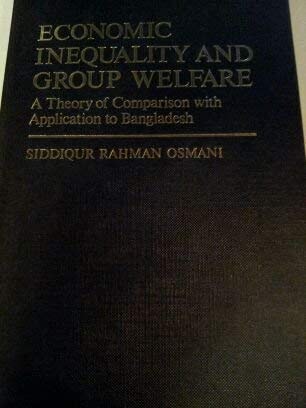
Economic Inequality and Group Welfare: A Theory of Comparison With Application to Bangladesh
0
0
As an Amazon Associate and affiliate partner, Menrva Books earns from qualifying purchases. Learn more
Author Description
Economic Inequality and Group Welfare: A Theory of Comparison With Application to Bangladesh explores the complex dynamics of inequality in a developing nation. S. R. Osmani presents a theoretical framework that emphasizes the role of social comparison in determining group welfare, moving beyond traditional income-based metrics. Through a detailed application to the context of Bangladesh, the book offers insights into how relative economic standing shapes social outcomes and policy challenges.
Menrva's Summary
THE THESIS
This work investigates the relationship between economic inequality and group welfare by proposing a theoretical framework based on social comparison. S. R. Osmani, a distinguished economist specializing in development and poverty, utilizes this framework to analyze the socio-economic landscape of Bangladesh. The book argues that individual well-being is not merely a function of absolute income but is significantly influenced by relative standing within specific social groups. By integrating theoretical modeling with empirical observation, the author provides a nuanced perspective on how inequality manifests and impacts collective welfare in developing nations.
THE SCOPE MAP
What You Will Find
- A theoretical model of social comparison and its impact on welfare distribution.
- Empirical analysis of income inequality and poverty metrics within Bangladesh.
- Methodological approaches to measuring group-based economic disparities.
- Policy implications for addressing inequality in developing economies.
THE AUTHORITY PERSPECTIVE
Experts in development economics recognize this text as a rigorous contribution to the study of welfare economics in South Asia. Readers frequently note the academic density of the prose and the sophisticated mathematical approach applied to social welfare theory.
Page Count:
190
Publication Date:
1982-08-26
Publisher:
Oxford University Press
ISBN-10:
019828425X
ISBN-13:
9780198284253
Economics
Bangladesh
Public welfare
Inequality
Social Science
Community Tags
Similar Books