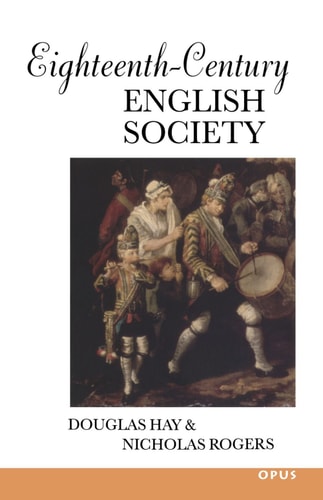
Eighteenth-Century English Society: Shuttles and Swords
0
0
As an Amazon Associate and affiliate partner, Menrva Books earns from qualifying purchases. Learn more
Author Description
The period from 1688-1820 was marked throughout with riots and rebellions, seditions and strikes, as the lower classes rebelled against the state bias towards the interests of higher social groups. Drawing on recent work on demography, labor, and law, this readable history of the period focuses on the experience of the eighty percent of the population who made up England's "lower orders." Hay and Rogers provide fresh insights into food shortages, changes in poor relief, use of the criminal law, and the shifts in social power caused by industrialization that would bring about the birth of working-class radicalism.
Menrva's Summary
THE THESIS
How did the social and economic tensions of the eighteenth century shape the emergence of working-class radicalism in England? Douglas Hay and Nicholas Rogers examine the period between 1688 and 1820, focusing on the systemic conflicts between the state and the lower orders. By integrating demographic data, labor history, and legal analysis, the authors argue that the state's bias toward elite interests catalyzed widespread social unrest and eventually fostered organized political resistance.
THE SCOPE MAP
What You Will Find
- Analysis of food shortages and their impact on social stability.
- Examination of the evolution of poor relief systems.
- Investigation into the application of criminal law as a tool of social control.
- Assessment of industrialization's role in shifting power dynamics.
Scope Limits
- The text focuses primarily on the lower classes and does not provide an exhaustive political history of the ruling elite.
- The analysis is geographically confined to England during the specified timeframe.
THE AUTHORITY PERSPECTIVE
Historians frequently cite this work as a significant contribution to the study of social conflict and class formation in pre-industrial England. Scholars note that the prose remains accessible to students while providing the rigorous analytical depth required for academic research.
Page Count:
272
Publication Date:
1997-07-10
Publisher:
Oxford University Press
ISBN-10:
0192891944
ISBN-13:
9780192891945
History
Social History
Sociology
Great Britain
18th century
Labor history
British History
Community Tags
Similar Books