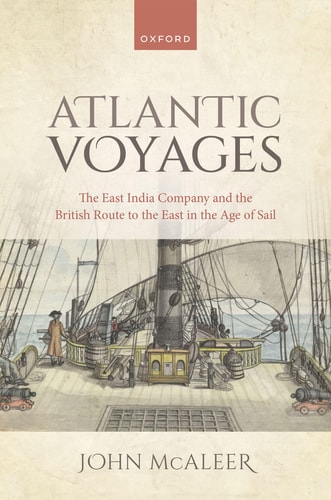
Atlantic Voyages: The East India Company and the British Route to the East in the Age of Sail
0
0
As an Amazon Associate and affiliate partner, Menrva Books earns from qualifying purchases. Learn more
Author Description
As he prepared to embark for India in 1774, Alexander Mackrabie's excitement at the sights to be seen and novelties to be experienced was palpable. Mackrabie's journey was conducted under the auspices of the London-based East India Company and was one of the many thousands of Company voyages that brought Europeans into contact with Asian countries and cultures, as well as numerous people and places along the way. Atlantic Voyages tells the story of travellers like Mackrabie as they navigated the waters of the Atlantic Ocean, reflecting on who and what they had left behind in Europe, looking forward to new challenges in Asia, and evaluating the sights and smells, sounds and tastes, hopes and expectations, fears and regrets, that regaled their senses and played on their minds as they sailed along the way. It charts the tension between tedium and terror on the one hand, and exhilaration and excitement on the other, attempting to understand the maritime space of the Atlantic as it was experienced by the people who traversed its waters.The lives of the people carried by East Indiamen were deeply affected by their Atlantic experiences. They confronted the reality of shipboard life: its seasickness and boredom, its cramped living conditions, its questionable dining fare, and its severely restricted privacy. They acclimatised to the rhythms of the ocean and the vicissitudes of the weather. They encountered rites of passage and ceremonies of initiation on the high seas. They prepared themselves for cultural disorientation and a host of unusual sights and sensations. And they wondered at the extraordinary beauty of the elements around them - the sea, the sky, the islands - and the strangeness of their inhabitants, human and animal alike. The ship's passage played a crucial role in shaping the responses and experiences of those individuals surrounded by its wooden walls. Their words bring to life this maritime journey, illuminate the experiences of the people who undertook it,
Menrva's Summary
THE THESIS
How did the maritime experience of the Atlantic crossing shape the perceptions and psychological states of individuals traveling to Asia under the East India Company? Dr. John McAleer, a specialist in imperial and maritime history, utilizes primary source accounts—such as the journals of Alexander Mackrabie—to reconstruct the lived reality of 18th-century sea travel. The book argues that the ship served as a transformative space where the tension between boredom and terror, combined with physical confinement, fundamentally altered the travelers' outlook before they even reached their destination.
THE SCOPE MAP
What You Will Find
- Analysis of 18th-century maritime travel conditions aboard East Indiamen vessels.
- Examination of psychological responses to long-term isolation and environmental exposure.
- Documentation of shipboard social rituals, rites of passage, and daily routines.
Scope Limits
- The study focuses primarily on the Atlantic leg of the voyage rather than the entirety of the route to India.
- It does not provide a comprehensive military or economic history of the East India Company.
THE AUTHORITY PERSPECTIVE
Historians and scholars of maritime studies recognize this work for its focus on the sensory and emotional history of colonial travel. Readers frequently note the accessible yet scholarly prose that effectively bridges the gap between academic research and human-centered narrative history.
Page Count:
272
Publication Date:
2023-01-01
Publisher:
Oxford University Press
ISBN-10:
0192894749
ISBN-13:
9780192894748
Travel
History
Social History
Great Britain
British Empire
Renaissance
Maritime history
Naval history
Community Tags
Similar Books