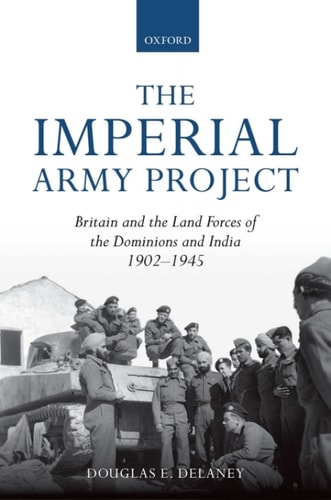
The Imperial Army Project: Britain and the Land Forces of the Dominions and India, 1902-1945
0
0
As an Amazon Associate and affiliate partner, Menrva Books earns from qualifying purchases. Learn more
Author Description
How did British authorities manage to secure the commitment of large dominion and Indian armies that could plan, fight, shoot, communicate, and sustain themselves, in concert with the British Army and with each other, during the era of the two world wars? What did the British want from the dominion and Indian armies and how did they go about trying to get it? Douglas E Delaney seeks to answer these questions to understand whether the imperial army project was successful. Answering these questions requires a long-term perspective — one that begins with efforts to fix the armies of the British Empire in the aftermath of their desultory performance in South Africa (1899-1903) and follows through to the high point of imperial military cooperation during the Second World War. Based on multi-archival research conducted in six different countries, on four continents, Delaney argues that the military compatibility of the British Empire armies was the product of a deliberate and enduring imperial army project, one that aimed at standardizing and piecing together the armies of the empire, while, at the same time, accommodating the burgeoning autonomy of the dominions and even India. At its core, this book is really about how a military coalition worked.
Menrva's Summary
THE THESIS
This book investigates how British authorities successfully coordinated the military forces of the dominions and India to ensure operational compatibility during the two world wars. Douglas E. Delaney, a specialist in military history, utilizes extensive multi-archival research across six countries to analyze the long-term efforts to standardize imperial military doctrine. He argues that the imperial army project was a deliberate, enduring initiative that balanced the necessity of military cohesion with the increasing political autonomy of the participating nations.
THE SCOPE MAP
What You Will Find
- Analysis of military standardization efforts from 1902 to 1945.
- Examination of the logistical and tactical integration of dominion and Indian armies.
- Primary source research from archives in six countries across four continents.
- Evaluation of the tension between imperial centralization and colonial autonomy.
Scope Limits
- The study focuses primarily on the structural and doctrinal aspects of military cooperation rather than individual combat narratives.
- The analysis concludes with the end of the Second World War and does not extend into the post-colonial era.
THE AUTHORITY PERSPECTIVE
Scholars and military historians recognize this work as a rigorous examination of coalition warfare within the British Empire. Readers frequently note the depth of the archival research and the clarity with which the author navigates complex administrative and political military history.
Page Count:
368
Publication Date:
2018-01-01
Publisher:
OUP Oxford
ISBN-10:
0191009652
ISBN-13:
9780191009655
History
European History
Military History
British
20th Century
Modern History
Warfare
Great Britain
British Empire