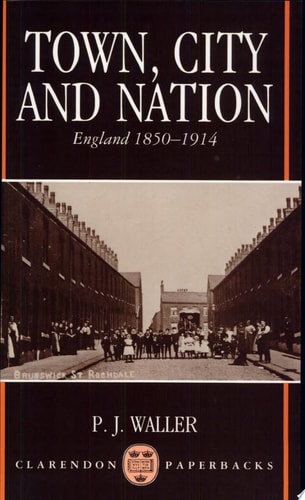
Town, City, and Nation: England in 1850-1914
0
0
As an Amazon Associate and affiliate partner, Menrva Books earns from qualifying purchases. Learn more
Author Description
By the outbreak of the First World War, England had become the world's first mass urban society. In just over sixty years the proportion of town-dwellers had risen from 50 to 80 percent, and during this period many of the most crucial developments in English urban society had taken place. This book provides a uniquely comprehensive analysis of those developments - conurbations, suburbs, satellite towns, garden cities, and seaside resorts. Waller assesses the importance of London, the provincial cities, and manufacturing centers. He also examines the continuing influence of the small country town and "rural" England on political, economic, and cultural growth. Scholarly and readable, this book is a general social history of late nineteenth and early twentieth-century England, seen from an urban perspective.
Menrva's Summary
THE THESIS
This work investigates the rapid transformation of England into the world's first mass urban society between 1850 and 1914. P.J. Waller, a historian specializing in British social history, utilizes demographic data and regional case studies to argue that the shift from rural to urban living fundamentally reshaped the political, economic, and cultural landscape of the nation. The text provides a framework for understanding how the growth of diverse urban forms—from manufacturing hubs to seaside resorts—interacted with the persistent influence of traditional rural structures.
THE SCOPE MAP
What You Will Find
- Analysis of urban development patterns including conurbations, suburbs, and garden cities
- Comparative study of London versus provincial manufacturing centers
- Examination of the interplay between urban expansion and rural cultural identity
Scope Limits
- The analysis is strictly confined to the period between 1850 and 1914
- The text focuses primarily on social and structural history rather than detailed military or diplomatic history
THE AUTHORITY PERSPECTIVE
Scholars and students of British history frequently cite this work as a comprehensive survey of the Victorian and Edwardian urban experience. Readers often note that the prose is accessible while maintaining the academic rigor expected of a social history text.
Page Count:
350
Publication Date:
1984-06-14
Publisher:
Clarendon Press
ISBN-10:
0192891634
ISBN-13:
9780192891631
History
Urban Studies
20th Century
Social History
19th Century
British History
Community Tags
Similar Books