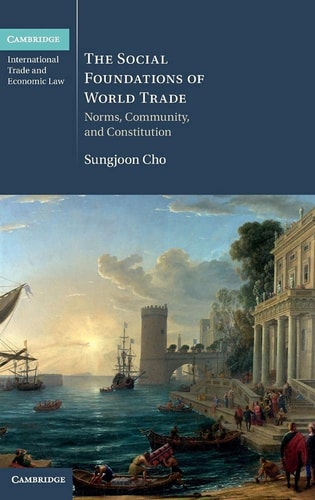
The Social Foundations of World Trade
0
0
As an Amazon Associate and affiliate partner, Menrva Books earns from qualifying purchases. Learn more
Author Description
As highlighted by Pascal Lamy, the former head of the WTO, world trade traditionally involves state-to-state contracts and is based on an anachronistic 'monolocation' production/trade model. It therefore struggles to handle new patterns of trade such as global value chains, which are based on a 'multilocation' model. Although it continues to provide world trade on a general level with a powerful heuristic, the traditional 'rationalist' approach inevitably leaves certain descriptive and normative blind spots. Descriptively, it fails to explain important ideational factors, such as culture and norms, which can effectively guide the behaviour of trading nations with or without material factors such as interests and utilities. Normatively, the innate positivism of the traditional model makes it oblivious to the moral imperatives of the current world trading system, such as development. This book emphatically redresses these blind spots by reconstructing the WTO as a world trade community from a social perspective.
Menrva's Summary
THE THESIS
This book challenges the traditional state-centric and rationalist models of world trade by proposing a social perspective that accounts for ideational factors and moral imperatives. The author, Sungjoon Cho, argues that existing trade frameworks, exemplified by the WTO's traditional approach, are ill-equipped to handle contemporary trade patterns like global value chains due to their reliance on an outdated 'monolocation' production model. By reconstructing the WTO as a world trade community, the book aims to address the descriptive and normative blind spots of the rationalist approach, which often overlooks the influence of culture and norms and the moral imperative of development.
THE SCOPE MAP
- Critique of the traditional state-to-state contract model of world trade.
- Analysis of the limitations of the 'monolocation' production/trade model.
- Exploration of global value chains and the 'multilocation' model.
- Examination of ideational factors (culture, norms) in guiding trading nation behavior.
- Discussion of the normative blind spots in the rationalist approach, particularly regarding development.
- Reconstruction of the WTO as a world trade community from a social perspective.
- Integration of sociological insights into the study of international trade.
THE AUTHORITY PERSPECTIVE
The book is presented as a significant re-evaluation of world trade theory, particularly concerning the role of the WTO. It aims to fill gaps in traditional rationalist economic models by incorporating social and ideational factors. The work is positioned to offer a more nuanced understanding of contemporary trade dynamics, emphasizing the importance of culture, norms, and development imperatives.
Page Count:
250
Publication Date:
2015-01-01
Publisher:
Cambridge University Press
ISBN-10:
1107036615
ISBN-13:
9781107036611
Politics
Economics
Non-Fiction
Sociology
International Trade
Community Tags
Similar Books