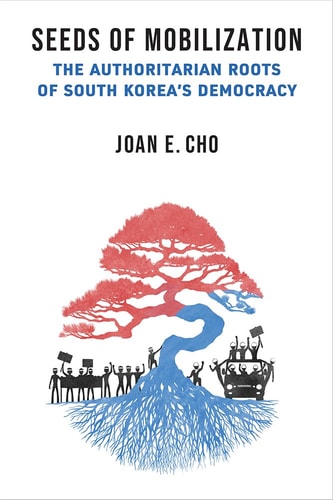
Seeds of Mobilization: The Authoritarian Roots of South Korea's Democracy
0
0
As an Amazon Associate and affiliate partner, Menrva Books earns from qualifying purchases. Learn more
Author Description
South Korea is sometimes held as a dream case of modernization theory, a testament to how economic development leads to democracy. Seeds of Mobilization takes a closer look at the history of South Korea to show that Korea’s advance to democracy was not linear. Instead, while Korea’s national economy grew dramatically under the regimes of Park Chung Hee (1961–79) and Chun Doo Hwan (1980–88), the political system first became increasingly authoritarian. Because modernization was founded on industrial complexes and tertiary education, these structures initially helped bolster the authoritarian regimes. In the long run, however, these structures later facilitated the anti-regime protests by various social movement groups—most importantly, workers and students—that ultimately brought democracy to the country. By using original subnational protest event datasets, government publications, oral interviews, and publications from labor and student movement organizations, Joan E. Cho takes a long view of democratization that incorporates the decades before and after South Korea’s democratic transition. She demonstrates that Korea’s democratization resulted from a combination of factors from below and from above, and that authoritarian development itself was a hidden root cause of democratic development in South Korea. Seeds of Mobilization shows how socioeconomic development did not create a steady pressure toward democracy but acted as a “double-edged sword” that initially stabilized autocratic regimes before destabilizing them over time.
Menrva's Summary
THE THESIS
The book investigates how South Korea's transition to democracy was not a direct result of economic development but rather a complex process shaped by authoritarian regimes. Joan E. Cho examines the history of South Korea, demonstrating that while economic growth occurred under authoritarian rule, the political system became increasingly repressive. Structures initially built to bolster these regimes, such as industrial complexes and tertiary education, later became instrumental in facilitating anti-regime protests. The author utilizes original subnational protest event datasets, government publications, oral interviews, and movement organization records to present a long-term perspective on democratization. Cho argues that authoritarian development itself was a hidden root cause of democratic development, acting as a 'double-edged sword' that initially stabilized autocracy before ultimately destabilizing it.
THE SCOPE MAP
- Analysis of South Korea's political and economic history from the 1960s to the 1980s.
- Examination of how industrial complexes and tertiary education initially supported authoritarian regimes.
- Exploration of the role of workers and students as key social movement groups in the push for democracy.
- Use of original subnational protest event datasets, government publications, and oral interviews as primary sources.
- A long-term perspective on democratization, incorporating periods before and after the democratic transition.
- The argument that authoritarian development paradoxically sowed the seeds for democratic change.
THE AUTHORITY PERSPECTIVE
The book is regarded as a significant contribution to the understanding of democratization, particularly in the context of modernization theory. It challenges the linear progression often assumed between economic development and democratic transition, highlighting the complex and often contradictory role of authoritarian regimes. The author's use of extensive primary sources and subnational data provides a robust foundation for her arguments. This work offers a nuanced perspective, suggesting that the very structures of authoritarian development can, over time, foster the conditions for democratic change.
Page Count:
276
Publication Date:
2024-02-13
Publisher:
University of Michigan Press
ISBN-10:
0472076604
ISBN-13:
9780472076604
Politics
History
Non-Fiction
Asian Studies
Authoritarianism
Sociology
Community Tags
Similar Books