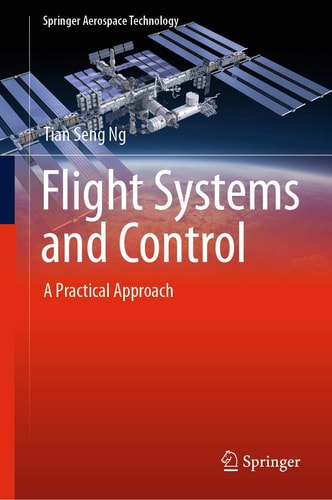
Flight Systems and Control: A Practical Approach
0
0
As an Amazon Associate and affiliate partner, Menrva Books earns from qualifying purchases. Learn more
Author Description
This book focuses on flight vehicles and their navigational systems, discussing different forms of flight structures and their control systems, from fixed wings to rotary crafts. Software simulation enables testing of the hardware without actual implementation, and the flight simulators, mechanics, glider development and navigation systems presented here are suitable for lab-based experimentation studies. It explores laboratory testing of flight navigational sensors, such as the magnetic, acceleration and Global Positioning System (GPS) units, and illustrates the six-axis inertial measurement unit (IMU) instrumentation as well as its data acquisition methodology. The book offers an introduction to the various unmanned aerial vehicle (UAV) systems and their accessories, including the linear quadratic regulator (LQR) method for controlling the rotorcraft. It also describes a Matrix Laboratory (MATLAB) control algorithm that simulates and runs the lab-based 3 degrees of freedom (DOF) helicopter, as well as LabVIEW software used to validate controller design and data acquisition. Lastly, the book explores future developments in aviation techniques.
Menrva's Summary
THE THESIS
This book investigates the intricate world of flight vehicles and their control systems, from traditional fixed-wing aircraft to complex rotary crafts. The author, Tian Seng Ng, draws upon practical applications and laboratory experimentation to explore the design, testing, and implementation of flight control systems. It details the use of software simulations and hardware testing for navigational sensors like GPS and IMUs, and introduces methods for controlling unmanned aerial vehicles (UAVs) such as the linear quadratic regulator (LQR). The book also covers the application of MATLAB and LabVIEW for simulation and validation, offering insights into future aviation advancements.
THE SCOPE MAP
- Detailed discussion of flight structures and their control systems, covering fixed-wing and rotary crafts.
- Exploration of software simulation for hardware testing without actual implementation.
- Laboratory testing of flight navigational sensors, including magnetic, acceleration, and GPS units.
- Illustration of six-axis inertial measurement unit (IMU) instrumentation and data acquisition methodology.
- Introduction to various unmanned aerial vehicle (UAV) systems and accessories.
- Application of the linear quadratic regulator (LQR) method for rotorcraft control.
- Description of MATLAB control algorithms for simulating and running a 3 DOF helicopter.
- Use of LabVIEW software for controller design validation and data acquisition.
THE AUTHORITY PERSPECTIVE
The book is presented as a practical guide for understanding flight systems and control, likely appealing to students and engineers in aerospace and related fields. Its focus on laboratory experimentation and simulation suggests a hands-on approach to learning complex concepts. The inclusion of specific control methods like LQR and software tools such as MATLAB and LabVIEW indicates a technical depth suitable for those seeking to apply theoretical knowledge. The exploration of UAV systems and future aviation techniques positions it as a relevant resource for current and emerging trends in the aerospace industry.
Page Count:
241
Publication Date:
2018-12-16
Publisher:
Springer Nature Singapore
ISBN-10:
9811342237
ISBN-13:
9789811342233
Non-Fiction
Science & Technology
Aerospace Engineering
Control systems
Robotics
Community Tags
Other Editions(2)
Similar Books