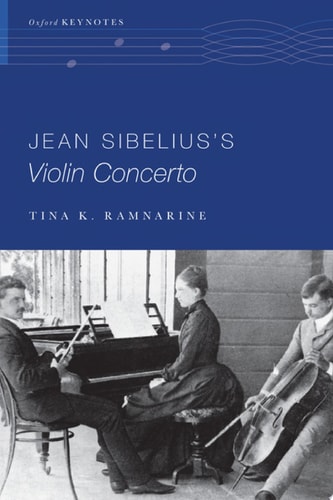
Jean Sibelius's Violin Concerto (The Oxford Keynotes Series)
0
0
As an Amazon Associate and affiliate partner, Menrva Books earns from qualifying purchases. Learn more
Author Description
Jean Sibelius's Violin Concerto is the story of Sibelius as performer and composer, of violin performing traditions, of histories of musical transmission, and of virtuosity itself. It investigates the history and legacy of one of the most recorded concertos in the violin repertoire. Sibelius, a celebrated and influential composer of the late 19th and 20th centuries, was an accomplished violinist, whose enduring interest in the instrument has been paralleled by the broad success of the only concerto in his oeuvre: his violin concerto (premiered in 1904 and revised in 1905). Considering how violinists engage with the work, author Tina K. Ramnarine discusses technology's central role in the concerto's transmission from Jascha Heifetz's seminal 1935 recording to contemporary online performances, gender issues in violin solo careers, and nature-based musical aesthetics that lead to thinking about the ecology of virtuosity in an era of environmental crisis. Beginning with Sibelius's early training as a violinist and his aspirations as a performer, Ramnarine traces the dramatic historical context of the violin concerto. It was composed as Finland underwent a period of heightened self-determination, nationalism, and protest against Russian imperial policies, and it heralded intense political dynamics relating to Europe's East-West border that have extended to the present. This story of the violin concerto points to the notion of Sibelius - and the virtuoso more generally - as a political figure.
Menrva's Summary
THE THESIS
This book investigates the historical, political, and aesthetic significance of Jean Sibelius's Violin Concerto, examining how the work functions as a nexus for performance tradition, national identity, and the evolution of virtuosity. Tina K. Ramnarine, a professor of music, utilizes a multidisciplinary approach to analyze the concerto's development from its 1904 premiere through its modern digital legacy. By situating the composition within the context of Finnish nationalism and the composer's own background as a violinist, the author argues that the work serves as a critical site for understanding the intersection of musical performance and political agency. The text synthesizes archival research, performance history, and contemporary ecological theory to frame the concerto as a living, evolving entity.
THE SCOPE MAP
What You Will Find
- Historical analysis of the concerto's composition during Finland's struggle for self-determination.
- Examination of the role of recording technology in shaping performance traditions from 1935 to the present.
- Discussion of gender dynamics within the history of violin solo careers.
- Exploration of nature-based aesthetics and the concept of the 'ecology of virtuosity.'
Scope Limits
- The text does not provide a technical musicological analysis of the score's harmonic or structural composition.
- It does not serve as a comprehensive biography of Sibelius, focusing instead on his relationship with the violin.
THE AUTHORITY PERSPECTIVE
Scholars and musicologists recognize this work as a nuanced contribution to the Oxford Keynotes series, praised for its ability to connect technical performance history with broader socio-political themes. Readers frequently note that the prose is accessible to both music students and general enthusiasts interested in the cultural impact of classical repertoire.
Page Count:
160
Publication Date:
2020-01-01
Publisher:
Oxford University Press
ISBN-10:
0190611561
ISBN-13:
9780190611569
Music
Biography
Music History
Humanities
Criticism history
Community Tags
Similar Books