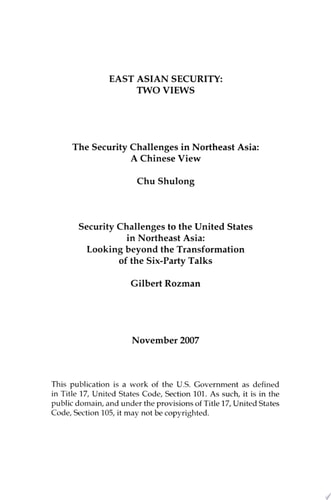
East Asian Security: Two Views
0
0
As an Amazon Associate and affiliate partner, Menrva Books earns from qualifying purchases. Learn more
Author Description
A new framework for Northeast Asian security must cope with the legacy of six decades of frequent changes in the region's great power relations. In order to realize the goals of the Joint Agreement in the Six-Party Talks, multilateralism is becoming more important. U.S. leadership faces challenges from: the Sino-U.S. rivalry that is better managed because of cooperation over North Korea; the Russo-U.S. rivalry that has intensified, although there is potential to stabilize it in this region; Sino-Russian partnership, which has drawn closer in response to the nuclear crisis but could be tested by progress that would reveal conflicting national interests; North Korean belligerence, which is unlikely to end even if the nuclear crisis is brought under control; South Korean balancing, which would remain even under a conservative president; and Sino-Japanese rivalry, which is somewhat under control in 2007 but remains the main barrier to regionalism. A U.S. regional strategy is needed that addresses all of these challenges in the context of the Six-Party Talks.
Menrva's Summary
THE THESIS
This book proposes a new framework for Northeast Asian security that grapples with the complex and evolving great power relations of the past six decades. The authors examine the increasing importance of multilateralism in achieving the goals of the Six-Party Talks, while detailing the significant challenges to U.S. leadership. These challenges stem from the Sino-U.S. rivalry, the intensified Russo-U.S. rivalry, the strengthening Sino-Russian partnership, North Korea's persistent belligerence, South Korea's strategic balancing, and the underlying Sino-Japanese rivalry. The work argues for a comprehensive U.S. regional strategy designed to address these multifaceted issues within the context of the Six-Party Talks.
THE SCOPE MAP
- Analysis of the legacy of six decades of great power relations in Northeast Asia.
- Examination of the role of multilateralism and the Six-Party Talks in regional security.
- Detailed assessment of the challenges posed by Sino-U.S., Russo-U.S., and Sino-Japanese rivalries.
- Evaluation of the dynamics of the Sino-Russian partnership and North Korean belligerence.
- Discussion of South Korean balancing strategies.
- Proposal for a U.S. regional strategy to manage these complex security challenges.
THE AUTHORITY PERSPECTIVE
The book offers a detailed analysis of the intricate security landscape in Northeast Asia, focusing on the interplay of major powers and the challenges to regional stability. It highlights the critical role of multilateral frameworks like the Six-Party Talks and proposes a strategic approach for U.S. engagement. The authors' examination of the various bilateral rivalries and partnerships provides a comprehensive overview of the region's security dynamics. This work is positioned as a valuable resource for understanding the complexities of East Asian security in the mid-2000s.
Page Count:
56
Publication Date:
2007-01-01
Publisher:
Strategic Studies Institute, U.S. Army War College
ISBN-10:
1584873248
ISBN-13:
9781584873242
Non-Fiction
History
Politics
Security Studies
Geopolitics
East Asia
International relations
Community Tags
Similar Books