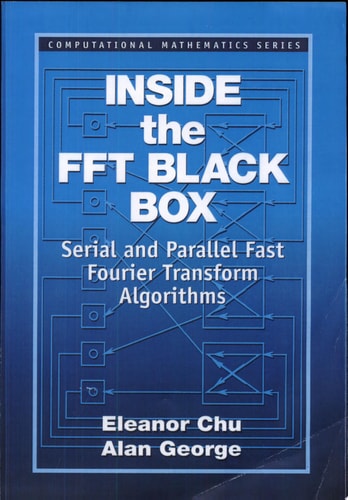
Inside the FFT Black Box: Serial and Parallel Fast Fourier Transform Algorithms
0
0
As an Amazon Associate and affiliate partner, Menrva Books earns from qualifying purchases. Learn more
Author Description
Are some areas of fast Fourier transforms still unclear to you? Do the notation and vocabulary seem inconsistent? Does your knowledge of their algorithmic aspects feel incomplete? The fast Fourier transform represents one of the most important advancements in scientific and engineering computing. Until now, however, treatments have been either brief, cryptic, intimidating, or not published in the open literature. Inside the FFT Black Box brings the numerous and varied ideas together in a common notational framework, clarifying vague FFT concepts. Examples and diagrams explain algorithms completely, with consistent notation. This approach connects the algorithms explicitly to the underlying mathematics. Reviews and explanations of FFT ideas taken from engineering, mathematics, and computer science journals teach the computational techniques relevant to FFT. Two appendices familiarize readers with the design and analysis of computer algorithms, as well. This volume employs a unified and systematic approach to FFT. It closes the gap between brief textbook introductions and intimidating treatments in the FFT literature. Inside the FFT Black Box provides an up-to-date, self-contained guide for learning the FFT and the multitude of ideas and computing techniques it employs.
Menrva's Summary
THE THESIS
This book aims to demystify the Fast Fourier Transform (FFT) by consolidating diverse concepts into a unified notational framework. The FFT is a cornerstone of scientific and engineering computation, yet existing treatments are often fragmented or inaccessible. This volume addresses this gap by providing clear explanations, consistent notation, and illustrative examples that explicitly link algorithms to their mathematical underpinnings. It draws upon a wide range of sources from engineering, mathematics, and computer science to teach essential computational techniques.
THE SCOPE MAP
- A unified notational framework for FFT concepts.
- Detailed explanations and diagrams of FFT algorithms.
- Explicit connections between algorithms and underlying mathematics.
- Reviews and explanations of FFT ideas from engineering, mathematics, and computer science literature.
- Coverage of serial and parallel FFT algorithms.
- Two appendices on the design and analysis of computer algorithms.
THE AUTHORITY PERSPECTIVE
The book is designed to bridge the gap between introductory textbook treatments and more advanced, potentially intimidating, literature on the Fast Fourier Transform. It aims to provide a self-contained guide for understanding FFT and its associated computational techniques. The approach emphasizes clarity, consistency, and the explicit connection between mathematical theory and algorithmic implementation. This volume is intended for readers seeking a comprehensive and accessible resource on this critical computational tool.
Page Count:
336
Publication Date:
1999-11-11
Publisher:
CRC Press
ISBN-10:
1420049968
ISBN-13:
9781420049961
Science & Technology
Non-Fiction
Science
Mathematics
Algorithms
Computer Science
Community Tags
Similar Books