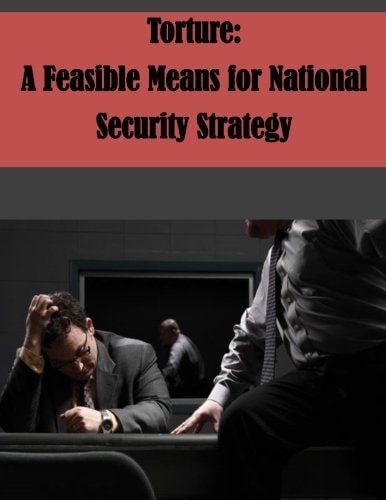
Torture: A Feasible Means for National Security Strategy
0
0
As an Amazon Associate and affiliate partner, Menrva Books earns from qualifying purchases. Learn more
Author Description
In the wake of the eleventh of September terrorist attacks on America, many things the nation's leaders once took for granted changed. One of the major changes initiated as a result of these attacks was national security policy. President George W. Bush viewed the attacks on the World Trade Center and the Pentagon as an act of war. One particular problem the country faced with this was the fact that the organization that carried out these attacks was not a state but a group of Islamic terrorists receiving explicit support from the government of Afghanistan. As a part of his response, President Bush declared that the country was at war with Al Qaida and any government that supported them. In the wake of this declaration of the Global War on Terrorism (GWOT), the United States found itself having to answer many difficult questions. One of these questions that would eventually cause an international outcry was the use of torture against captured enemy fighters. The United States, a strong proponent for humanitarian law, soon found itself criticized for its treatment of detainees as well as its use of secret prisons. In short, the international community accused the United States of committing acts of torture. As a result of these accusations, commentators and politicians have had endless debates about torture warrants, the use of waterboarding, stress positions and other interrogation techniques, and legal applicability of international law and treaties to a nonstate enemy. In light of this controversy, the purpose of this study is therefore to examine the major arguments both for and against the use of torture, to examine these arguments against an ethical decision-making model, and to see if torture is really a feasible resource for the United States to employ in pursuit of its goals as defined in the 2006 National Security Strategy.
Menrva's Summary
THE THESIS
This study examines the ethical and practical feasibility of employing torture as a national security strategy in the post-9/11 era. Following the terrorist attacks of September 11, 2001, the United States redefined its national security policy, leading to the Global War on Terrorism and subsequent debates over interrogation techniques. This work specifically investigates the arguments for and against the use of torture, analyzes these arguments through an ethical decision-making model, and assesses whether torture is a viable resource for achieving U.S. goals as outlined in the 2006 National Security Strategy.
THE SCOPE MAP
- Analysis of the major arguments for the use of torture in national security.
- Analysis of the major arguments against the use of torture in national security.
- Examination of torture arguments against an ethical decision-making model.
- Assessment of torture's feasibility as a resource for U.S. national security goals.
- Contextualization within the post-9/11 geopolitical landscape and the Global War on Terrorism.
- Discussion of international outcry and criticism regarding U.S. treatment of detainees and secret prisons.
- Consideration of debates surrounding torture warrants, waterboarding, stress positions, and international law applicability to non-state enemies.
THE AUTHORITY PERSPECTIVE
This work directly addresses the controversial topic of torture as a national security tool, a subject that generated significant international debate and legal scrutiny following the 9/11 attacks. By examining arguments for and against its use through an ethical framework, the study aims to provide a structured analysis of its feasibility. The research is grounded in the context of the 2006 National Security Strategy and the broader Global War on Terrorism, indicating a focus on policy and ethical implications.
Page Count:
86
Publication Date:
2014-06-24
Publisher:
CreateSpace Independent Publishing Platform
ISBN-10:
1500294551
ISBN-13:
9781500294557
Politics
Philosophy
Non-Fiction
History
Community Tags
Similar Books