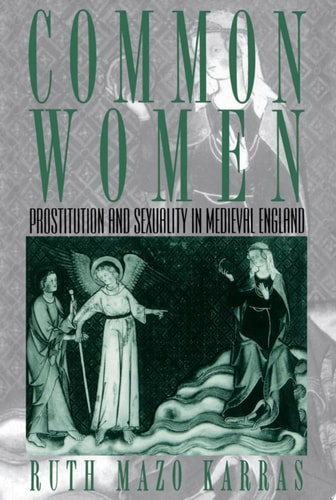
Common Women: Prostitution and Sexuality in Medieval England
0
0
As an Amazon Associate and affiliate partner, Menrva Books earns from qualifying purchases. Learn more
Author Description
Through a sensitive use of a wide variety of imaginative and didactic texts, Ruth Karras shows that while prostitutes as individuals were marginalized within medieval culture, prostitution as an institution was central to the medieval understanding of what it meant to be a woman. This important work will be of interest to scholars and students of history, women's studies, and the history of sexuality.
Menrva's Summary
THE THESIS
This work investigates how the institution of prostitution functioned as a central component in the medieval construction of female identity and social order. Ruth Mazo Karras, a historian specializing in medieval gender and sexuality, utilizes a diverse array of primary sources—ranging from legal records and didactic literature to imaginative texts—to analyze the paradox of the prostitute as a marginalized individual who nonetheless occupied a structural role in medieval society. Her framework challenges traditional historical narratives by positioning the sex trade as an integral part of the medieval urban landscape rather than a peripheral phenomenon.
THE SCOPE MAP
What You Will Find
- Analysis of legal and ecclesiastical regulations governing sex work in medieval England.
- Examination of how medieval literature and moral treatises defined female sexuality.
- Case studies derived from urban records and court documents.
- Discussion of the socioeconomic status of women within the medieval sex trade.
Scope Limits
- The study is geographically restricted primarily to medieval England.
- The analysis does not focus on the personal biographies of individual sex workers, but rather on the institutional and cultural framework.
THE AUTHORITY PERSPECTIVE
Historians and scholars of gender studies frequently cite this text as a foundational resource for understanding the intersection of social marginalization and institutional necessity in the Middle Ages. Readers often note the academic density of the prose, which provides a rigorous examination of the complex social dynamics surrounding medieval sexuality.
Page Count:
228
Publication Date:
1998-01-01
Publisher:
Oxford University Press
ISBN-10:
0190284226
ISBN-13:
9780190284220
History
Sexuality
Social History
Prostitutes
Prostitution
Woman Studies
European History
Gender Studies
Womens Studies
Sex
Great Britain