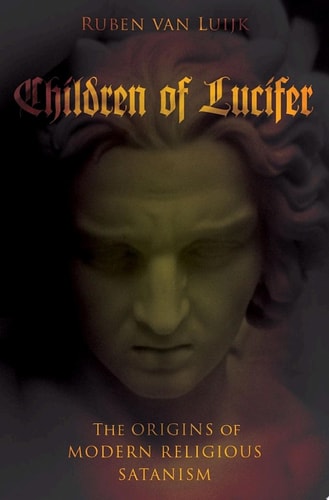
Children of Lucifer: The Origins of Modern Religious Satanism
0
0
As an Amazon Associate and affiliate partner, Menrva Books earns from qualifying purchases. Learn more
Author Description
If we are to believe sensationalist media coverage, Satanism is, at its most benign, the purview of people who dress in black, adorn themselves with skull and pentagram paraphernalia, and listen to heavy metal. At its most sinister, its adherents are worshippers of evil incarnate and engage in violent and perverse secret rituals, the details of which mainstream society imagines with a fascination verging on the obscene. Children of Lucifer debunks these facile characterizations by exploring the historical origins of modern Satanism. Ruben van Luijk traces the movement's development from a concept invented by a Christian church eager to demonize its internal and external competitors to a positive (anti-)religious identity embraced by various groups in the modern West. Van Luijk offers a comprehensive intellectual history of this long and unpredictable trajectory. This story involves Romantic poets, radical anarchists, eccentric esotericists, Decadent writers, and schismatic exorcists, among others, and culminates in the establishment of the Church of Satan by carnival entertainer Anton Szandor LaVey. Yet it is more than a collection of colorful characters and unlikely historical episodes. The emergence of new attitudes toward Satan proves to be intimately linked to the ideological struggle for emancipation that transformed the West and is epitomized by the American and French Revolutions. It is also closely connected to secularization, that other exceptional historical process which saw Western culture spontaneously renounce its traditional gods and enter into a self-imposed state of religious indecision. Children of Lucifer makes the case that the emergence of Satanism presents a shadow history of the evolution of modern civilization as we know it. Offering the most comprehensive account of this history yet written, van Luijk proves that, in the case of Satanism, the facts are much more interesting than the fiction.
Menrva's Summary
THE THESIS
This book investigates the historical evolution of Satanism from a theological construct used to demonize religious rivals into a distinct, self-identified modern religious movement. Ruben van Luijk, a scholar specializing in Western esotericism, utilizes an extensive archival approach to trace how shifting cultural attitudes toward authority and secularization facilitated the emergence of Satanism. He argues that the development of this identity is inextricably linked to the broader ideological struggles for emancipation that defined the American and French Revolutions.
THE SCOPE MAP
What You Will Find
- A historical analysis of the transition from Christian polemical demonization to modern self-identification.
- Profiles of key figures including Romantic poets, anarchists, and Anton Szandor LaVey.
- An examination of the intersection between secularization and the rise of counter-cultural religious identities.
Scope Limits
- The text focuses primarily on Western developments and does not provide an exhaustive global survey of all non-Western satanic-adjacent practices.
- It does not function as a theological manual for practitioners but rather as an academic historical study.
THE AUTHORITY PERSPECTIVE
Scholars and historians of religion recognize this work as a rigorous, comprehensive intellectual history that successfully moves beyond sensationalist tropes. Readers frequently note the academic density of the prose, which provides a thorough and well-documented examination of the subject matter.
Page Count:
629
Publication Date:
2016-01-01
Publisher:
Oxford University Press
ISBN-10:
019027512X
ISBN-13:
9780190275129
History
Religion
Special Topics
Sociology of Religion
Body Mind Spirit
Occultism
Satanism
Intellectual History
Community Tags
Similar Books